



Her husband, however, has always possessed that profound inner serenity and self-belief that we tend to associate with his cricketing equivalent, Sachin Tendulkar. At no stage in Anand's remarkable career — he is the first player to have won the world title in three different formats — was this more evident than in the final game of last month's match. The Bulgarian had the white pieces. This is always a slight advantage, but with Topalov it means much more. Like all great players of a violent attacking style, he is especially fearsome with the initiative of the first move. He is the chess equivalent of the tennis player with a 130mph serve.
In this last game, with his title at stake, Anand abandoned his normal double-edged counterattacking systems, and chose, for the first time in his career, the ultra-solid defence to the Queen's Gambit developed in the early 20th century by Emanuel Lasker. He seemed to be telling Topalov: "I have no intention of trying to win this game. But I will stop you from winning, too." Perhaps Anand, a shrewd psychologist, knew of Topalov's agitation about the fact that the "penalty shoot-out" was scheduled for May 13. Perhaps he felt too mentally drained himself to want to attempt anything more than straightforward defence — he said, after the game, that the match had aged him "by ten years". Whatever the reason, it was a master-stroke: the Bulgarian was provoked into playing too sharply in an effort to refute Anand's unfashionably conservative set-up, and at the critical stage played a couple of obviously risky moves almost without thought — both of them blunders.
After the game, the experts argued that Topalov had miscalculated, that he had simply missed Anand's deadly response, as the Indian switched from obdurate defence into lethal counterattack. My own view is that much more than miscalculation was the cause of the Bulgarian's blunders. His nerve went. He cracked. In front of his own supporters, in the most important game of his life, the occasion was too much for him. It was almost as if he would rather lose than stand another minute of such unbearable tension. I suspect that he will never recover completely, as a player or even as a person, from this traumatic experience. There are some sporting setbacks that leave mental scars that cannot be erased.
Here then are the moves of that remarkable game, which demonstrated both the greatness of Viswanathan Anand and the triumph of true self-confidence over mere aggression.
1.d4 d5 2.c4 e6 3.Nf3 Nf6 4.Nc3 Be7 5.Bg5 h6 6.Bh4 0-0 7.e3 Ne4 (and here it is, the super-solid Lasker Defence.) 8.Bxe7 Qxe7 9.Rc1 c6 10.Be2 Nxc3 11.Rxc3 dxc4 12.Bxc4 Nd7 13.0-0 b6 14.Bd3 c5 15.Be4 Rb8 16.Qc2 Nf6 17.dxc5 Nxe4 18.Qxe4 bxc5 19.Qc2 Bb7 20.Nd2 Rfd8 21.f3 Ba6 22.Rf2 Rd7 23.g3 Rbd8 24.Kg2 Bd3 25.Qc1 Ba6! (The critical moment, in the purely psychological sense. Anand is saying to Topalov: would you like just to repeat the position with 26.Qc2 and have a draw? ) 26.Ra3 (No!) Bb7 27. Nb3 Rc7 28.Na5 Ba8 29.Nc4 e5 30.e4 f5! (Anand suddenly switches to the attack. Topalov's next two moves, played almost instantly, betray complete disorientation) 31. exf5? e4! 32.fxe4? Qxe4+ 33.Kh3 Rd4 34.Ne3 Qe8!! (If Topalov missed anything specific, it must have been this lethal retreat, threatening Qh5 mate.) 35.g4 h5 36.Kh4 g5 37.fxg6 Qxg6 38.Qf1 Rxg4+ 39.Kh3 Re7 40.Rf8+ Kg7 41.Nf5+ (The puzzle will explain why Topalov played this.) Kh7 42.Rg3 Rxg3+ 43.hxg3 Qg4+ 44.Kh2 Re2+ 45.Kg1 Rg2+ 46.Qxg2 Bxg2 47.Kxg2 Qe2+ 48.Kh3 c4 49.a4 a5 50.Rf6 Kg8 51.Nh6+ Kg7 52.Rb6 Qe4 53.Kh2 Kh7 54.Rd6 Qe5 55.Nf7 Qxb2+ 56.Kh3 Qg7 and Topalov finally conceded the game and with it the world championship.
Puzzle: The climax of one of the great games of chess history: why didn’t Topalov simply capture Anand’s deadly Bishop with 41.Rxa8?
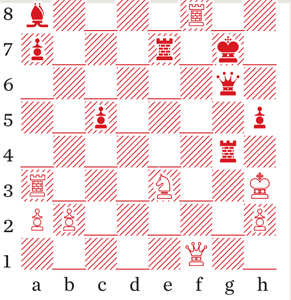
Solution: After 41.Rxa8 Anand had prepared this elegant execution: 41…Rxe3+! 42. Rxe3 Rh4+!! 43.Kxh4 Qg4 checkmate!.


Post your comment

- Islam and the French Republic
- Why On Earth Should Anyone Study Philosophy?
- The Dying Days Of Zuma's South Africa
- His Master's Voice: Scruton On Wagner
- Why The Most Civilised Of Men Felt Like A Fraud
- Political Misconduct
- Cicero's Analysis Of Decline Offers Lessons For The West
- Trump's Appeal Is More Roosevelt Than Reagan