



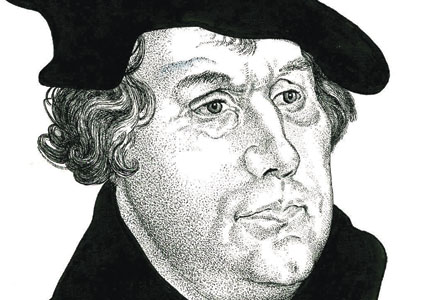
 Exaggerated influence: Martin Luther (Illustration by Michael Daley)
Martin Luther was the first man of the modern era to create his own myth. Much of what we think we know about him may never have happened. He probably never told the Emperor Charles V at the Diet of Worms: “Here I stand. I can do no other.” He probably didn’t nail his Ninety-five Theses to the church door in Wittenberg — the quincentenary of which will be celebrated in 2017. And he almost certainly never threw an inkwell at the Devil; the stain on the wall of his room at the Wartburg that tourists are shown to this day is a fake.
What is true about Luther is that he was a theologian: even by the standards of German professors, he was extraordinarily prolific. The Weimar edition of his works was begun in 1883 and only completed in 2009, by which time it had run to 121 volumes. His unparalleled verbosity has fuelled countless biographies, several more of which have been occasioned by this anniversary. So large does he loom in historiography that he almost defies objectivity — but like so many “great men” his influence has been exaggerated.
First, Luther’s Reformation was neither necessary nor sufficient for the rise of Western civilisation. The “freedom of a Christian” he preached was certainly not political liberty — he was brutally vindictive towards the peasants who took him literally — nor did it have much to do with religious toleration. There was no contradiction in Luther’s mind between Reformation and authority; indeed Protestant Germany remained a bastion of absolutism for the next three centuries. Christendom, already divided between the Catholic West and the Orthodox East, was severely weakened in its existential struggle with the Ottoman Empire by the schism provoked by Luther.
That schism rendered impossible the more moderate reform programme of humanist scholars such as Erasmus and More. Nor did Luther care much about science or the arts (except music): it was the Renaissance, not the Reformation, that inaugurated modernity. Luther’s most creative (as opposed to polemical) contribution to European culture, his German translation of the Bible, would justify his place in history — but if he had not defied the pope and emperor he might have gained their support for the vernacular Bible.
Second, Luther’s Reformation was not a prerequisite for the rise of capitalism in Europe. That process was already well under way and the wars of religion of the 16th and 17th centuries only delayed it. The economic ideas that Max Weber attributed to the Reformation were more highly developed in the Catholic school of Salamanca.
Like this article? Share, save or print using the icons below:


- Time To Revisit The Two Cultures
- The Battle Against The Philistines Never Ceases
- Who Will Do Justice To Our Judiciary?
- How The EU Elite Paved The Way For Populism
- Trump's Appeal Is More Roosevelt Than Reagan
- Anything Dennett Can Do, Scruton Does Meta
- Why France Is Revolting Against The Ancien Regime
- A Letter To Our Great-Grandchildren
1:02 AM
6:02 PM
6:02 PM
5:12 PM
4:12 PM
9:11 AM