


No one could beat McShane in the 2010 London Chess Classic. Even playing Black, he held both Anand and Kramnik to draws although the Russian ex-world champion had pounded away at Luke for no fewer than 139 moves before conceding that McShane's defences were impenetrable. In fact, very long games are a McShane hallmark — and usually it is he who is doing all the pressing. When I asked him what his main strength was, Luke told me: "I fight very hard at the board." Most chess grandmasters will get up many times during the game, and wander around to look at the positions of other players in the tournament hall, or just to relax a bit. Luke, however, almost invariably sits at his board for the full length of the game, concentrating ferociously, even when it is his opponent's turn to move.
His remarkable powers of concentration delivered the goods again in January: Luke, as he put it to me, "at 27, now quite old for a chess player", took first place in a very strong second-string tournament in Wijk-an-Zee. With that victory he also won the right to play in the Premier event next year, against, among others, his old rival from the under-10 world championship, Levon Aronian. Here is his win, playing White in the penultimate round against the Filipino Grandmaster Wesley So, himself an ex-prodigy who became a grandmaster at the age of 14. The notes are based on Luke's own explanations to me immediately after the game.
At the time he and So were tied for first place, so everything was at stake: 1.e4 c6 2.d4 d5 3.e5 Bf5 4.h4 h5 5.c4 e6 6.Nc3 Nd7 7.Nge2 dxc4 8.Ng3 Nb6 9.Be2 Bg6 10.Bg5 Be7 11.Nge4 f6 12.Bf4 Nd5 13.Bg3 Qb6! ("Most of Black's moves came as a surprise to me, including this one. But I understood that I was in trouble and came up with what I thought was my only chance") 14.0-0 Nxc3 15.Nxc3 Qxb2 16.Bxc4!!? (This brilliantly imaginative piece sacrifice is what McShane had in mind. It may not be entirely sound, but at least he will now have the initiative) Qxc3 17.Rac1 Qb2 18.Bxe6 Rad8 19.d5 fxe5 20.Rfe1 Bf6 21.Re2 Qa3 22.Bxe5 Bxe5 23.Rxe5 Kf8 24.Qe1 Qd6? (A blunder by So but even after the much better 24...Nf6 McShane still has compensation for the piece) 25.Bxg8 Kxg8 26.Re6 Qxd5 27.Rxg6 Rh6? (Another error, but Black's position was now very hard to defend) 28.Rxh6 gxh6 29.Qe3 Rd7 30.Qxh6 Rg7 31.g3 Qd4 32.Qe6+ Rf7 33.Qe2 Kg7 34.Rf1! (Not falling for So's devilish trap: 34.Rd1? Rxf2! 35.Qe7+ Rf7+ 36.Rxd4 Rxe7) Kg6 35.Rd1 (Now this works: if 35...Rxf2? 36.Qe8+ and any Black discovered check is useless). Qf6 36.Qe3 b6 37.Rd4 Re7 38.Qd3+ Kg7 39.Rf4 Qe6 40.Rf5 Rf7 and So resigned, because McShane's next is 41.Rg5+ with two principal variations: 41...Kf8 42.Qd8+ Qe8 43.Rg8+ winning the Queen and 41...Kh6 42.Qd1! with the deadly threat of Qh5 mate. More, please, Luke!
Puzzle: Here is Luke McShane (Black) at the age of eight, in the process of winning the world under-10 championship. His opponent, Etienne Bacrot, now ranked in the world’s top twenty, chose to play 38.b5 in this position. Why was this not a very bright idea?
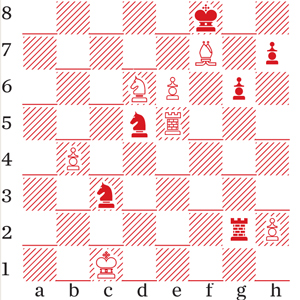
Solution: Little Luke replied with 38...Nb4! Sure, Bacrot can play 39.e7+, but after 39.Kg7, White can’t play 40 e8=Q because Black has can deliver mate in one of three ways, either by Nb4-a2, Nd3 or Rc2! It now dawned on Bacrot that, in fact, he cannot defend against these multiple mates, so he resigned. Had Bacrot played 38.e7+ Nxe7, the French boy would have deflected Black’s Knight from the attack, with a draw in prospect. Quel dommage!


10:03 PM