


Encouragingly, the two young Iranians were not blocked by their government from competing, despite the fact that a number of Israeli players were also taking part in this great annual chess event — though I did wonder what would have happened if either of them had been drawn to play against one of the Israeli entrants.
Sarasadat in particular seems a remarkably mature 18-year-old, who has already attained the rank of international master. She is one of the beneficiaries of the fact that the Tehran government has invested heavily in chess: for two years it engaged our own Nigel Short as the national chess coach.
This is all the more remarkable given that, after the Islamic Revolution of 1979, chess was banned in the country (again, based on a confusion with an early version of the game played with dice) and went underground. But in 1988 Ayatollah Khomeini reversed his fatwa. Chess parks and chess palaces sprang up on fertile intellectual soil. Occasionally a cleric has tried to reverse this burgeoning movement with the tired old incantation that chess is “un-Islamic”, but in Iran, at least, this game seems to be up for the religious old guard; and last year, the renaissance of chess in one of its most important ancestral homes had an impact on the international stage when Masoud Mosadeghpour won the world under-18 championship.
In any case, the Muslim world does not consist solely of Saudi Arabia and Iran. There is North Africa, too: and it was strangely fitting that the first Arabic speaker to win any form of world title is a namesake of one of those participants in the first recorded chess match. In 2007, more than a millennium later, Ahmed Adly of Egypt won the World Junior (under-20) Championship — following in the steps of such precocious talents as Boris Spassky, Anatoly Karpov and Gary Kasparov. Adly’s triumph — unlike that of those three predecessors from the Soviet Union — was delightfully unexpected. The following game, in which Adly defeated one of the tournament favourites, the Hungarian grandmaster Viktor Laznicka, was a luminous achievement.
1.e4 c5 2.Nf3 e6 3.d3 (Adly’s favoured approach, avoiding the more heavily-analysed main lines with 3.d4) …Nc6 4.g3 d5 5.Nbd2 Nf6 6.Bg2 Be7 7.0-0 b6 8.Re1 Bb7 9.e5 Nd7 10.c4 Qc7 11.cxd5 exd5 12.d4 Nf8 13.Nf1 Ne6 14.dxc5 bxc5 15.Ne3 d4 16.Nd5 Qd7 17.Nd2 Nb4 18.Nxe7 Bxg2 19.Nf5 Bd5 20.Ne4 Kf8 21.a3 Nc6 22.Qh5 d3? (This gives Adly the chance of a dazzling finish. Laznicka would actually stand better after 22…Bxe4! 23.Rxe4 g6 24.Qh6+ Kg8 25.Nd6 Nxe5 26.Rxe5 Qxd6) 23.Nf6!! gxf6 24.Qh6+ Kg8 25.exf6 Re8 26.Bf4! (a fantastic manoeuvre, preparing to take the f8 escape square from Black’s King) Re8 27.Bd6 Ncd4 28.Qg7+! and Laznicki resigned, seeing that after 28…Nxg7 29.Nh6 is a beautiful mate. In fact Adly could also have sacrificed his Queen with either 28.Qf8+ or 28.Qg5+: however it is captured, the reply is, again, 29.Nh6 mate.
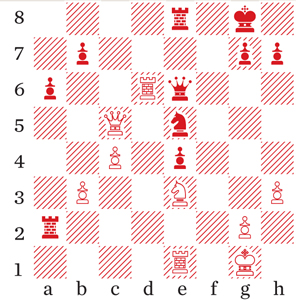
Puzzle: The Arabian mate, so called because it was first described by players from that region in the 13th century, involves the King being mated in the corner by Rook and Knight alone. This should give you a clue to the solution of this month’s puzzle. It is not an example to give much pleasure to Saudi Arabia’s Grand Mufti, as the winning player is David Janowski, a Jew who was also an inveterate casino gambler. Can you see how Janowski, playing black, finished off his opponent, Isidor Gunsberg, in this game from 1902?
Solution: Janowski uncorked 28…Nf3+! After 29.gxf3 Qxh3 White’s King is too exposed to survive, while 29.Kf1 Qf7 30. Qd5 Qxd5 31.Nxd5 Nxe1 32.Kxe1 Rxg2 is also hopeless. So Gunsberg declined the sacrifice with 29.Kh1, which allowed the conclusion 29…Qxh3+ 30.gxh3 Rh2++. Voila: the Arabian mate.


