


This was no accident. Petrosian was a devoted disciple of the great teacher Aron Nimzovich, who eulogised the notion of the "mysterious" move. Many grandmasters would be lulled by the Armenian's apparently pointless manoeuvrings, until it dawned on them, much too late, that they had been completely encircled. Thus, the Dutch ex-world champion Max Euwe pointed out, in a flurry of zoological metaphors, that, despite his first name, "Tigran Petrosian is not a tiger that pounces on his play, but rather a python that smothers its victim or even a crocodile, waiting for hours for a convenient moment to strike."
For all its critics, this style was fantastically effective at world championship level. After all, Petrosian was either a defending world champion or a candidate for that honour in ten consecutive three-year cycles. This was an unmatched record of durability—and doubtless his tendency to fight hard in only a minority of his games minimised the stress on the nervous system, which causes many at the highest level to burn out after showing dazzling early promise.
In his superb book, The Battle of Chess Ideas, Dr Anthony Saidy described Petrosian as the appropriate world champion in the "age of the anti-hero". He concluded his chapter on him by observing: "To base one's campaign on the capacity to foresee and forestall every threat of the adversary is an impressive and original contribution to the evolution of chess thought. But it is not a creative, artistic achievement. It is a negation of the beauty and richness of the chess god Caissa."
Much as I admire Dr Saidy's book, I think this is most unfair on Petrosian. The Armenian was, for all his dour professionalism, a true artist of the chess board when the Muse was upon him. In fact, I would argue that no player in the modern era has produced anything that surpasses Petrosian's best games in sheer beauty and harmony of expression.
That is why, in the freezing winter of 1977, I spent a fortnight in Hastings to see Petrosian in the annual tournament which has taken place in that resort every year since 1895. He was no longer world champion, but still had a certain aura about him. And I was delighted to see the very way in which he moved the pieces—with tremendous and fastidious delicacy, as if stirring a extremely rare tea with an ivory spoon.
I was rewarded in a more thrilling way, as were the other spectators, when Petrosian played a game against the British grandmaster John Nunn, which can properly be described as a work of art. I felt, watching it unfold, as perhaps an art student might find the experience of being in the presence of a great painter as he puts the finishing touches to a masterpiece. This is what happened, with Petrosian playing White.
1.d4 Nf6 2.c4 c5 3.d5 e6 4.Nc3 exd5 5.cxd5 d6 6.Nf3 g6 7.Nd2 Bg7 8.Nc4 0-0 9.Bg5 h6 10.Bf4 b6 11.Bxd6 Re8 12.Bg3 Ne4 13.Nxe4 Rxe4 14.e3 b5 15.Nd2 Rb4 16.b3!! (Petrosian at his best, completely refuting Black's premature attack)...Bxa1 17.Qxa1 Qxd5 18.a3 Rg4 19.Be2 Nc6 20.Bf3 Qe6 21.Bxg4 Qxg4 22.0-0 Bb7 23.f3 Qe6 24.Ne4 Rd8 25.Nxc5 Qxe3+ 26.Bf2 Qe7 27.Re1 Qc7 28.h4 h5 29.Ne4 Ne7 30.Nf6+ Kf8 31.b4!! (The second delicate move of the b-pawn, and this time it's a killer, preparing to fix the White Bishop on c5)...Bc8 32.Nxh5 gxh5 33.Qh8+ Ng8 34.Bc5+ Rd6 35.Qe5 and Nunn resigned, since Bxd6+ comes next, with utter annihilation.
Happy 80th Birthday, Tigran.
Puzzle: Petrosian’s tactical genius was under-appreciated—although not by his opponents. Here is one of his most stunning coups, against the Czech Grandmaster Ludek Pachman, from the Bled tournament of 1961. If you are looking for a spectacular finish, you will easily find Petrosian’s first move. But can you see the follow-up?
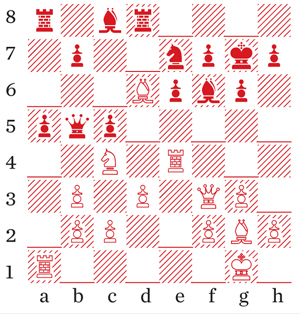
Solution: Petrosian sacrificed his Queen with 19.Qxf6+!. After 19…Kxf6 20.Be5+ Kg5 played the stunning ‘quiet’ move 21.Bg7!!—and Pachman resigned. Now that the h6 square is covered by the White Bishop, mate can’t be avoided: for example, if 21…Nf5 22.h4+ Nxh4 23.gxh4+ Kf5 Bh3 mate, or if 21…Kh5 22.Bf3+ Kg5 23.h4+ Kf5 24.Bg4 mate.


- The Zombie Argument that Refuses to Die
- Online Only: The Price Paid for Criticising Islam
- Overrated: Dan Brown
- Overrated: George Monbiot
- Is the Brain the Key to Understanding Religion?
- 'Please Sir, I Just Want to Learn More'
- An Assault on Free Speech at the LSE
- The Alternative History of an Undivided India
- The Zombie Argument that Refuses to Die
- Online Only: The Price Paid for Criticising Islam
- Overrated: Dan Brown
- Overrated: George Monbiot
- Is the Brain the Key to Understanding Religion?
- 'Please Sir, I Just Want to Learn More'
- An Assault on Free Speech at the LSE
- The Alternative History of an Undivided India
- Decline and Fall of the History Men
- Uncritical Theorists Who Misread the Nazis
- The Zombie Argument that Refuses to Die
- The Banality of Hannah Arendt
- From Kitsch to Cool: Picasso and Modern Art
- Is the Brain the Key to Understanding Religion?
- Time to Wise Up to the Muslim Brotherhood
- Midfield Virtuoso Finds His Perfect Pitch
- Online Only: The Price Paid for Criticising Islam
- Overrated: George Monbiot
- Letter from Ukraine: Reviving Lost Literature
- On Pilgrimage with the Hasids
- The Blob Has Run Schools For Decades. Not Any More
- Tsar Of The Holy Land
- Bismarck Versus Blair — A Foreign Policy Crossroads
- My Dieting Guide: Listen To Mother
5:07 PM