



I imagine that any young British would-be chess talent will want to know how to be the next Carlsen. I am afraid the answer is that first of all you need something approaching a divine gift. Of course it helps to have a parent dedicated to the game and your success. Magnus's father, Henrik, is a keen and strong club player who for years nurtured his boy's talent and has a blog
informing the world about all Magnus's exploits.
Yet no amount of parental dedication can create a genius — just the environment in which it can best develop. I recall seeing games from Norwegian events when Magnus was just ten and being dumbstruck by their precocious quality. In fact, to use some hyperbole, I couldn't believe my eyes. Illogically, I was even more astounded by the fact that the little genius was from Norway, a country with no great chess culture. Somehow, it would have seemed less astonishing if this freakish talent had emerged from the former Soviet Union, as Garry Kasparov did. Terrifyingly for Carlsen's opponents in London, his father has now signed up Kasparov to be his son's coach. In October, the initial effects of this signing were immediately apparent: Carlsen won the Nanjing supergrandmaster tournament by an astonishingly wide margin, and his opening play, until now his sole weakness, had been visibly improved by his work with Kasparov.
Unusually for a young player, Carlsen's greatest strength is in the ending, the most subtle aspect of the game and therefore the part at which mastery normally takes longest to achieve. Since endings tend to occur after many hours of play, they also favour the most patient and durable. Here is where Carlsen shows he is not just a genius: he also, unlike Capablanca, has phenomenal will-power and desire for victory and thus is prepared to sit for aeons grinding away in pursuit of the slimmest of advantages, or indeed, no advantage at all.
Yet Magnus is not just some Nordic nerd, constructed more of silicon than carbon. According to Pein, he is a very well rounded character, with a highly developed sense of humour: "He can recite entire scenes from Monty Python — in English — off by heart." I have a feeling that a number of Carlsen's chessboard opponents in London next month are going to get the serial amputation treatment handed out to Monty Python's Black Knight.
Even the world champion, Viswanathan Anand, has been made to look foolish by Carlsen. Here is what happened in a blindfold "game" between them earlier this year, with Carlsen playing Black.
1.e4 c5 2.Nf3 Nc6 3.Bb5 d6 4.0-0 Bd7 5.Re1 Nf6 6.c3 a6 7.Bf1 Bg4 8.d3 e6 9.Nbd2 Be7 10.h3 Bh5 11.g4 Bg6 12.Nh4 Nd7 13.Ng2 h5 14.f4 hxg4 15.hxg4 Qc7 16.Nf3 0-0-0 17.Ne3 Nb6 18.Nc4 Nxc4 19.dxc4 f5 20.exf5 exf5 21.g5 Bf7 22.Qc2 g6 23.Qf2 d5 24.cxd5 Bxd5 25.Be3 Bxg5!! (The blindfolded Carlsen "sees" what the champion has missed. If now 26.Nxg5 then it's mate on the spot with Rh1; and if 26.fxg5 then Bxf3 and White can't recapture because then it's mate with Qh2!) 26.Qg3 Be7 27.Bg2 g5! 28.Nxg5 Bxg5 29.Bxd5 Rxd5 30.Qxg5 Qf7 31.Kf2 Rh2+ 32.Kf1 Rd8 33.Qg3 Qc4+ 34.Kg1 Rxb2 and Anand resigned: Carlsen's Rook will come to g8 next move, with slaughter to follow.
Puzzle: Black to play. Can you see how the ten-year-old Carlsen stunned his grown-up opponent Gaasland in this game from 2001?
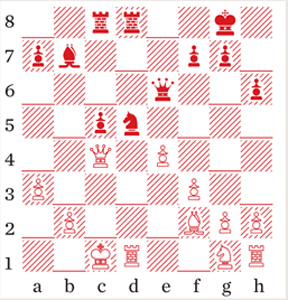
Solution: 1…Ne3!! threatening Rxd1 mate; the game continued 2.Rxd8+ Rxd8 3.Qe2; now Carlsen uncorked Qc4+!! and Gaasland resigned since after 4.Qxc4 Rd1 checkmate.


Post your comment

- Conduct Unbecoming: The Classical Commentaries of Norman Lebrecht in Standpoint
- Propaganda Shouldn’t Pay
- The US Can Still Help Save Syria — and Iraq
- A Putrid Pact between Devils
- Strangers in their own Holy Land
- The Taboo of the Tombola
- Putin has his Useful Idiots on the Left and the Right
- Russian Resurgence has Blindsided Nato