


His former colleague Peter Wright (later to become notorious for his book Spy catcher) blamed Alexander's relatively early death on the immense mental strain and responsibility of his work in cryptanalysis over more than 30 years. That is mere speculation. Yet what is true and remarkable is that Alexander combined this more than full-time task with leading the British chess team at no fewer than six Olympiads.
As Milner-Barry remarks: "When one remembers that he always put his profession first, it is astonishing that he should have been able to maintain himself as England's leading chess player for some 25 years."
Indeed, those six Olympiads would have been eight, were it not for the fact that Britain would not allow Alexander to play either behind or even anywhere near the Iron Curtain, so valuable did they believe the contents of his brains would be to our Cold War foes. Thus it was only when the leading Soviet and Eastern European players could be persuaded to play in the UK — or in matches conducted through the medium of the telegraph — that Alexander could match his chess skill against theirs. Yet on these rare occasions, Alexander — in an era when the Soviet chess players were generally regarded as unbeatable — proved himself able to win against the very best, something which no British player would be able to emulate until the arrival of Tony Miles in the 1980s.
The best example of this was the annual Hastings Tournament in the winter of 1953/4. Alexander came joint first with Russia's David Bronstein, then the world's number two, and ahead of such leading Grandmasters as Tolush, Matanovic, Olafsson, Teschner and Tartakower.
Most sensationally, Alexander crushed the former Soviet champion Tolush in the final round, having beaten Bronstein earlier in a marathon game which took three days to complete and which put chess on the front page of the British tabloid newspapers for possibly the only time in history.
As a leading player in the secret battles of the Cold War, Alexander would have well understood the unfortunate consequences for both his Soviet opponents in losing so unexpectedly to him. They were subjected to harsh criticism on their return and Bronstein in particular lost some of his privileges. Yet one suspects he would not have lost too much sleep over this. As Milner-Barry recorded: "Hugh himself said that he did not particularly care for people, and could get on perfectly well without them. The first statement was manifestly untrue, but he was certainly far from being a sentimentalist. There was plenty of Irish toughness about him, and his realistic attitude to life sometimes bordered on the ruthless."
Puzzle: Only 12 moves have been played in the game Alexander v. Cordingly 1947. Yet Alexander now forced immediate resignation. What is the killer blow?
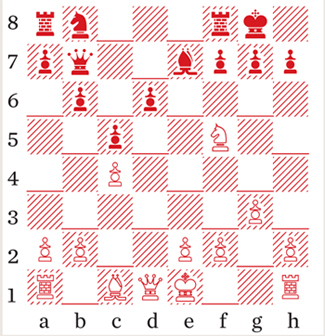
Solution: Alexander played 13.Qd5!!. After 13...Qxd5 14.Nxe7+ followed by 15.Nxd5 wins a piece; after 13. ..Nc6 simply 14.Qxc6! followed by 15.Nxe7+and 16.Nxc6; and after the desperate 13... Qc7 14.Qxa8 Nc6 the trick still works: 15.Qxc6! Qxc6 16.Nxe7+ and 17.Nxc6


