


Bourdieu used this term in part because it derives from ludus, Latin for "game". It is no surprise that the chess-fixated Desjarlais embraces Bourdieu's expansion of this fundamental insight: "The game presents itself to someone caught up in it, absorbed in it, as a transcendent universe, imposing its own ends and norms unconditionally."
Although this might seem an isolated kind of pleasure, the fact that chess is a game means that we must play with others; and while a big tournament for amateurs might appear to be nothing more than hundreds of people sitting in silence, that is to ignore the post mortems: after the game (if neither is too upset) the participants will go into an analysis room, and spend time discussing what happened and, much more fascinatingly, what might have happened, if only...
This is where the illusio is fully shared: two people with nothing in common except the game they have just played, who may never see each other again, yet who for an hour or so will be absolutely focused on each other's thoughts in a way which renders them unaware of anything else in the world. Bliss, in other words.
It is also possible that the struggle in the game has been so uncomfortable, with such underlying feelings of unexpressed hostility, that no amiable sharing of the illusio is possible. Desjarlais writes well about this, describing how some seemingly trivial personal tic of one's opponent can become inexpressibly infuriating, making the sense of harmony in which one would like to play all but impossible.
In the spirit of Desjarlais's own admissions of fear and loathing on the amateur chess circuit, I own up to behaving rather less than perfectly in the Hastings New Year Weekend Tournament in 2010. In the first round I lost to a 13-year-old Indian girl, who twirled her hair in a teenagerish way while unleashing a series of tactics which destroyed my position and my self-esteem. Then, in the next round I found myself paired against an 11-year-old: a boy called Peter Andreev, who had recently performed outstandingly for England in the European Junior Team championships. Nevertheless, my rating was still much higher than his, which meant that I had even more reason to dread a second humiliation at the hands of a child.
Before the game his father appeared to be whispering words of advice in Russian, which was fine; but then the tiny boy spent the first few minutes of the game staring at me with what seemed a deliberate look of contempt. As a result I did something appallingly childish myself: when young Andreev made a bad error as early as the 11th move, I thumped out my reply and glared at him with what I intended to be the same look he had given me.
Here, with apologies to my opponent, is that game: I had the Black pieces. 1.e4 d6 2.d4 g6 3.f4 Bg7 4.Nc3 a6 5.a4 b6 6.Nf3 Bb7 7.Bd3 Nf6 8.e5 Nfd7 9.0-0 0-0 10.Be3 c5 11.Ne4? c4 (This trick was what Andreev missed, although 11...cxd4 12.Bxd4 Nc6 would also have been bad for him) 12.Bxc4 Bxe4 13.e6 d5 14.exf7+ Rxf7 15.Bb3 Bxf3 16.Qxf3 e6 17.c4 Nf6 18.Rac1 Ra7 19.g4 Qd7 20.g5? (20.f5 was his last chance to confuse the issue) Ne4 21.cxd5 exd5 22.a5 b5 23.Rc2 Nc6 and White resigned, since his entire position is about to drop off.
Puzzle: Here is the conclusion of a game Robert Desjarlais describes in his book, against fellow amateur Vladimir Grechikhin, from a Manhattan Chess Club weekend tournament in 2003. Desjarlais ignored the threat to his Bishop and played 64...Kf3. Should the opponent capture the stray prelate?
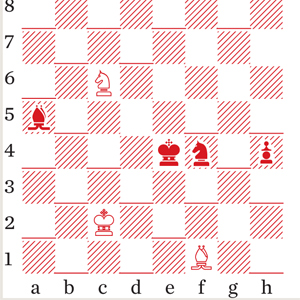
Solution: Grechikhin shouldn't, but he did. After 65.Nxa5 Kf2 66.Ba6 h3 67.Nc4 h2 68.Bb7 Ng2 Desjarlais described how his opponent "jerked his head back", only now realising that he cannot prevent the h-pawn from queening.


Post your comment

- The Zombie Argument that Refuses to Die
- Online Only: The Price Paid for Criticising Islam
- Overrated: Dan Brown
- Overrated: George Monbiot
- Is the Brain the Key to Understanding Religion?
- 'Please Sir, I Just Want to Learn More'
- An Assault on Free Speech at the LSE
- The Alternative History of an Undivided India
- The Zombie Argument that Refuses to Die
- Online Only: The Price Paid for Criticising Islam
- Overrated: Dan Brown
- Overrated: George Monbiot
- Is the Brain the Key to Understanding Religion?
- 'Please Sir, I Just Want to Learn More'
- An Assault on Free Speech at the LSE
- The Alternative History of an Undivided India
- Decline and Fall of the History Men
- Uncritical Theorists Who Misread the Nazis
- The Zombie Argument that Refuses to Die
- The Banality of Hannah Arendt
- From Kitsch to Cool: Picasso and Modern Art
- Is the Brain the Key to Understanding Religion?
- Time to Wise Up to the Muslim Brotherhood
- Midfield Virtuoso Finds His Perfect Pitch
- Online Only: The Price Paid for Criticising Islam
- Overrated: George Monbiot
- Letter from Ukraine: Reviving Lost Literature
- On Pilgrimage with the Hasids
- The Blob Has Run Schools For Decades. Not Any More
- Tsar Of The Holy Land
- Bismarck Versus Blair — A Foreign Policy Crossroads
- My Dieting Guide: Listen To Mother