


In this respect, Mickey's chess style is in tune with his character. He is a quiet man — "of few words" as one admiring article about him in a Russian chess publication observed. He also likes to work on his own. Unlike many other top players, he does not bring a grandmaster assistant or coach with him to the big tournaments. As he put it to me: "I've never found it perfect working with others. I prefer to work on my own. You're on your own at the board, after all."
This embrace of a certain form of solitariness is possibly the result of his having been born and brought up in Cornwall (both his parents are Cornish), far away from the centre of things. He had very little in the way of chess coaching — and quickly became far too good for any of the local players. At the age of nine, just three years after learning how to move the pieces, he won the Cornish under-15 and under-18 chess championships-playing in both events simultaneously, patiently trotting from one room to the other. Adams left school after taking his GCSEs and became a full-time chess professional at 15, by which time he had already become the world's youngest International Master.
Yet for all the apparent strangeness of his life, Adams is in no sense the chess oddball of popular prejudice. He is happily married to the Irish actress Tara MacGowran and, while he is much more of a listener than a talker, Mickey is in his laconic way most articulate — as readers of his weekly chess column in the Daily Telegraph will appreciate.
Perhaps Mickey's greatest personal asset as a chessplayer (apart from sheer talent) is his imperturbability. He is neither over-excited by success nor depressed by failure — like Kipling's definition of a man, he treats those two imposters just the same. I recall his calm comment to me after his worst-ever result, when he lost five games in the London Chess Classic of 2011: "These things happen," he said. "Another time I'll play not much better and win as many games."
Perhaps not surprisingly, Adams's most difficult opponent has been the world's highest-rated player, Magnus Carlsen. But when Norway met England in the 2010 Chess Olympiad, our number one, playing White, finally managed to breach Carlsen's defences: 1.e4 g6 2.d4 Nf6 3.e5 Nh5!? 4.Be2 d6 (an extraordinary opening by Carlsen. It looks as though White can gain a huge plus with 5.Bxh5 gxh5 6.Qxh5. But after 6...Rg8 7.Nf3 Rxg2 8.Ng5 Rxg5! 9.Bxg5 dxe5 10.dxe5 Qd4! Black is actually better) 5.Nf3! (Adams characteristically avoids all unnecessary complications) Nc6 6.exd6 exd6 7.d5 Ne7 8.c4 Bg7 9.Nc3 0-0 10.0-0 Bg4 11.Re1 Re8 12.h3 Bxf3 13.Bxf3 Nf6 14.Bf4 Nd7 15.Rc1 Ne5 16.b3 a6 17.g3 Nf5 18.Bg2 g5 19.Bxe5 Bxe5 20.Ne4 Ng7 21.Qd2 h6 22.f4 gxf4 23.gxf4 Bf6 24.Kh2 Nh5 25.Rg1 Kh7 26.Rcf1 Rg8 27.Qe2 Ng7 28.Qd3 Kh8 29.Bf3! (The start of a deadly manoeuvre with the King's Bishop: Spiderman is spinning a web to catch the juiciest of flies) b5 30.Bd1 bxc4 31.bxc4 Bh4 32.Bc2 f5 33.Rg6 (threatening nothing less than Rxh6 mate) Kh7 34.Rfg1! (Now if Carlsen grabs the Knight with fxe4 then 35.Qxe4 leads to mate in 4) Qe7 35.Ng3 Bxg3+ 36.Qxg3 Qf7 (the most stubborn defence is 36...Nh5 but then 37.Qf3! Rxg6 38.Bxf5 Ng7 39.Bd3 wins) 37.Bd1! Rae8 38.Rxh6+! and Carlsen resigned. The point of Adams's quietly lethal 37.Bd1 is seen in the denouement 38...Kxh6 39.Qg5+ Kh7 40.Qh4+ Nh5 41.Bxh5 and Carlsen's King is not long for this world.
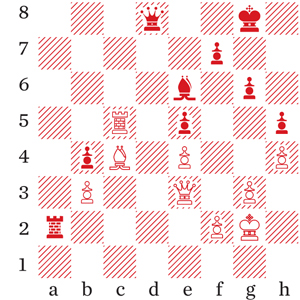
Puzzle: Reigning world champion Vishy Anand very rarely misses a tactical trick, but in this innocuous-looking position from their game in the London Chess Classic last year Mickey Adams (Black, to play) found a devastating continuation. Can you do as well?
Solution: Adams played 41…Qd1!! The point is that after the obvious 42.Bxe6 then 42…Ra1! leaves Anand’s King defenceless. He could then try 43.Bxf7+ with the idea 43…Kxf7?? 44.Qf3+ but Adams would simply have continued 44…Kg7! and now Anand has no more checks. In the game the world champion answered 41…Qd1!! with 42.Qh6 but Adams then wrapped up with the neat 42…Bh3+! forcing mate in two.


