



John's strength as a player, not surprisingly, lay in his extraordinary powers of concrete calculation: what he lacked, at the very highest level, was brute competitiveness and the sort of intuitive "feel" for positions exhibited by (for example) Magnus Carlsen. In fact Carlsen has cited Nunn as the embodiment of why "extreme intelligence" might be a hindrance to reaching the highest level in chess: "He has so incredibly much in his head. Simply too much. His enormous powers of understanding and his constant thirst for knowledge distracted him from chess."
However, it did not prevent John from becoming the world champion at chess problem-solving on three occasions (2004, 2007 and 2010). But then problems, being the closest in chess to pure mathematics, and without the psychological stress of facing an opponent across the same board, are ideally suited to Nunn's special gifts.
In one respect Nunn's approach to chess defied pure logic. While theory suggests that White has a very slight advantage which Black must first neutralise before playing for a win, John always preferred from the outset to go for a quick knockout with the Black pieces. Of course, this from time to time backfired, but when it came off it was spectacular — as in the following victory against no less an opponent than Viktor Korchnoi, who at the time (1981) was the world's second-highest-rated player.
However, it did not prevent John from becoming the world champion at chess problem-solving on three occasions (2004, 2007 and 2010). But then problems, being the closest in chess to pure mathematics, and without the psychological stress of facing an opponent across the same board, are ideally suited to Nunn's special gifts.
In one respect Nunn's approach to chess defied pure logic. While theory suggests that White has a very slight advantage which Black must first neutralise before playing for a win, John always preferred from the outset to go for a quick knockout with the Black pieces. Of course, this from time to time backfired, but when it came off it was spectacular — as in the following victory against no less an opponent than Viktor Korchnoi, who at the time (1981) was the world's second-highest-rated player.
1.c4 Nf6 2.Nc3 g6 3.e4 d6 (Nunn plays the enormously double-edged King’s Indian Defence—knowing that his redoubtable opponent had a massive plus score against it) 4.d4 Bg7 5.Be2 0-0 6.Nf3 Nbd7 7.0-0 e5 8.Qc2 a5 9.Rd1 exd4 10.Nxd4 Nc5 11.Ndb5 Re8 12.Bg5 Bd7 13.f3 Ne6 14.Be3 Nh5 15.Bf1 f5! 16.exf5 gxf5 (Korchnoi cannot now play 17.Qxf5 because after 17…Nef4 the discovered attacks on White’s Queen on f5 and Bishop on e3 win a piece) 17.Bf2 Rf8 18.g3 Nf6!? (Nunn once again invites his opponent to grab the pawn on f5. Korchnoi was famed for refuting unsound sacrifices, so this is deliberately provocative) 19.Qxf5? (Korchnoi is duly provoked. A less confident player would have settled for 19.Bg2) Ng4!! (An astonishing follow-up sacrifice, which Korchnoi cannot have anticipated) 20. Qxg4 Ng5 (The idea becomes clear: White’s Queen has been lured to its doom) 21. Qh5 Be8 22. Qxg5 (If 22.Qg4 h5 23.Qh4 Nxf3+ wins her majesty) Qxg5 23.Nxc7 (If Nunn now moves his attacked Rook on a8 Korchnoi will play 24.Ne6 forking Queen on g5 and Rook on f8, after which White has neutralized Black’s attack and has sufficient assorted material for his lost Queen. Nunn instead insists on maintaining the initiative with an inspired double rook sacrifice) Rxf3!! 25.Nxa8 Rxf2! 26.Kxf2 Qc5+ 26.Kg2? (It later emerged that the only defence was 26.Kf3 but Korchnoi can’t be blamed for not pushing his King further into the open) Bxc3 27.Nc7 (After 27.bxc3 Bc6+ 28.Rd5 Bxd5+ 29.cxd5 Qxc3 White cannot save his remaining Rook) Bg6 28.Nd5 Be4+ 29.Kh3 Bxb2 30.Rab1 Qf2 31.Rxb2 Qxb2 32.Nf4 Bf5+ 33.g4 Qf2! Korchnoi resigned. After 34.gxf5 Qf3+ 35.Kh4 Qxf4+ 36.Kh3 Qf3+ the massacre is complete. A game of extreme violence from the cerebral Dr Nunn.
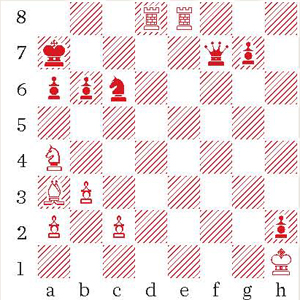
Puzzle: An example of clinical calculation from the 19-year-old Max Euwe (White, to move) in 1920 against one of the strongest players in the world at the time, Richard Réti. White can satisfactorily block Black’s threats with 28.Rf8. But he has something much better: can you see what it was?
Solution: Euwe played 28.Re7+! Nxe7 29.Rd7+ Ka8 30.Nxb6+ Kb8 31.Bd6 checkmate. Réti could have played 29…Kb8 but then 30.Bd6+ Ka8 31.Nxb6 is checkmate. QED.
Like this article? Share, save or print using the icons below:


