



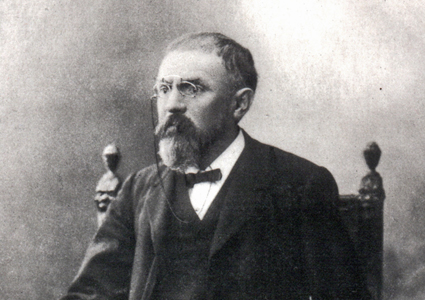
 Henri Poincaré: So far ahead of his time that we are still catching up
This Standpoint column gives scientists a forum to express their ideas publicly, though doing so is not easy. Among those who were good at it was the great French scientist Henri Poincaré — not to be confused with his cousin Raymond Poincaré, who was President of France during the First World War. Henri died in 1912 before that war, and if I could reincarnate one figure from the past to comment on modern scientific ideas and breakthroughs, it would be him.
Poincaré arrived at the main ideas of Relativity Theory before Einstein, foreseeing the gravitational implications that emerged later, and a putative 1970s textbook on relativity by a top Princeton mathematician was never published when it was seen to downplay Einstein's role relative to Poincaré's. In fact the two men's work was independent and as the French physicist Louis de Broglie wrote, "he left to Einstein the glory of seeing all the consequences of relativity and, in particular . . . the true physical character of the relationship the principle of relativity establishes between space and time". Why? De Broglie gives an answer in a 1954 address, available on YouTube: it was "without doubt his a little too hypercritical turn of mind, due to his having first been a pure mathematician, that was the cause".
These quotations appear in Henri Poincaré: A Scientific Biography by Jeremy Gray (Princeton, £24.95). It is full of the mathematical, physical and metaphysical ideas of a man who was not only a dispassionate observer of the world around us, but of our way of understanding it. Epistemology was a vital subject for him and one of his favourite questions was, "How do we know that?" As a disinterested observer he was even called in to examine the Dreyfus case, and completely demolished the "proof" that the handwriting of the main incriminating document was that of the accused. It wasn't.
Henri Poincaré, born in 1854, could already talk at nine months, and during his fourth year at the Lycée (13-14 years) his teacher called at the Poincaré house to say that the boy would be a mathematician. When his mother, who rather liked mathematics, appeared not unduly surprised, the teacher added, "I mean to say, a great mathematician."


