



Hardy himself never commented publicly on Eliot's work, though according to his biographers, he did copy some passages from "The Love Song of J. Alfred Prufrock" into his notebook, as an example of the "free verse" he reprobated in conversation. English social life being what it was (and in some respects still is), it would seem that Hardy never fully recovered from the humiliation of having had a cultivated mother, whom he loved greatly, employed as a domestic servant in other people's households and a father who had earned his living as a stonemason. Like his fictional character, Jude, Hardy was tormented in his youth and later by the conviction that his own and his family's lowly social status had denied him many advantages: the chief of these, perhaps, being the opportunity to get into Oxford. Yet for all he could know, and for all we will ever know, and certainly for all that Eliot ever knew, that enforced escape from Oxford may have been the making of him as an artist. The supposed absence from his life of "institutional attachment" or "objective beliefs" notwithstanding.
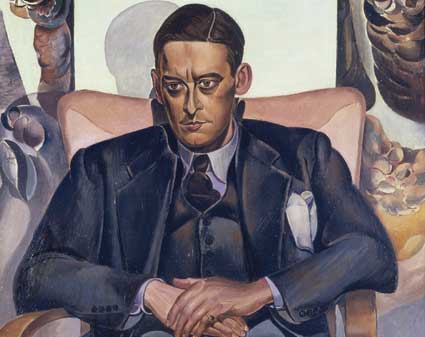
Wyndham Lewis's 1938 portrait of T.S. Eliot
In Hardy's verse, as in his prose, there is never any intimation of a supernatural world that can be reached or should be striven for beyond the common, earthly one that all humans inhabit. The "objective belief" that Hardy clung to throughout his life was that while we bring to the world a variety of passions which help to determine our fates, overall our lives remain governed by a mixture of choice, chance and temporal succession, from which there is no escape and to which we ultimately have to submit as stoically as we can. For Hardy, it is precisely the sense of a remorseless, blind successiveness ultimately governing all human (and animal) experience that makes so heartbreaking the crucially significant moments that many of his poems describe. Such moments may change our lives at a stroke, yet whatever their origin or outcome may be, they remain indifferent to both our hopes and inclinations and are incapable of responding to the meanings we impute to them or may try to take from them. Indeed, in large part it is our sense of their inscrutability, their "out-of-reachness", that helps to make these moments as significant to us as they are.
Strangely enough, it is precisely in this connection that one can find a similarity of sorts between Eliot and Hardy: which is to say that they are both preoccupied with the unpredictability of whatever moments of illumination may come our way, and hence with the consequences they may bring in their wake. Given the differences between the two men in background, character, taste, belief, modes of versification and habits of mind, they obviously express this preoccupation in different ways and draw different conclusions from what any such visitation might suggest. Nevertheless their openness to this kind of experience does make them brothers of a kind. Both men are obsessed with what Hardy called "the quality of time". Hence, as poets, they share not only a capacity to describe in their verse moments that they feel to have been of a truly transfiguring intensity, but also the compulsion to try to relate such moments with "the waste sad time stretching before and after", as Eliot calls it, with a note of both despair and dismissiveness that is special to him, and which is seldom heard even in the most melancholy of Hardy's poems.
Glum and despairing the latter's poems often are — at times even half-comically so, like a child kicking at a bedstead; and all the poet's invocations to God, the Fates, the Spirits, the Immanent Will, Voices from the Graveyard and countless other such capitalised Presences, cannot conceal from the reader that references of this kind are never to be taken literally. Rather, they are no more than the words the poet uses to reveal our incapacities: never a mode of actually calling in aid the processes that are forever going about their business around us, and of which we are, willy-nilly, a part. Whereas Eliot — certainly in what can be called his devotional poetry — writes out of hope and expectation, and seldom does so with more intensity than when he actually chides himself for daring to hope and expect:


2:11 AM