



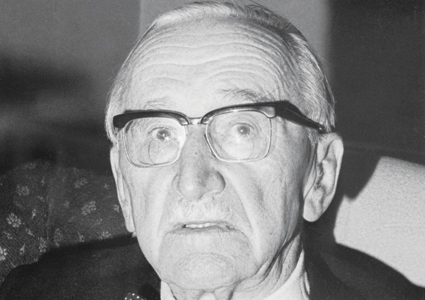
 Friedrich Hayek: In later life he worked on his moral philosophy
A quarter of a century ago, Friedrich Hayek (1899-1992), winner of the Nobel Memorial Prize in Economic Sciences, published his final contribution to his considerable corpus, an eloquent exposition of his enduring concerns. But The Fatal Conceit (1988) sought not to recapitulate the intricacies of his economic thought (despite its subtitle,"The Errors of Socialism"), or to revisit his postulated and widely celebrated connection of economic collectivism and political tyranny. Rather, he was now, four years from his death, occupied in this short and forgotten volume with one of the most fundamental questions of humankind: the basis and preservation of our civilisation.
By civilisation, Hayek meant the "extended order of human cooperation", also known ("misleadingly") as capitalism. This order, and, more specifically, the traditional morality upon which it rested, Hayek claimed, has been enabled by something other than human instinct and other than reason. The fatal conceit itself, he explained, is excessive faith in reason, based on an erroneous and dangerous notion that we can construct what in fact we must inherit or learn. This conceit is fatal because it results in the collapse of society and the return to savage instinct. Rather, morality lies between instinct and reason, and "learning how to behave is more the source than the result of insight, reason, and understanding".
Unlike his economic and political philosophies, Hayek's moral philosophy is less known, and yet it formed the culmination of his life's work. His critique of reason is profound, but his own understanding of traditional morality is found lacking, and he appears to have agreed.
Hayek sees the centralising impulse of contemporary Western political economy as stemming from a "presumptive rationalism" which he calls "scientism" or "constructivism", and which expresses the "spirit of the age". This presumption is the product of a "litany of errors", which he seeks to disentangle and expose. Specifically, he cites four basic philosophical concepts which, during the past several hundred years, have formed the basis of this way of thinking: rationalism, which denies the acceptability of beliefs founded on anything but experience and reasoning; empiricism, which maintains that all statements claiming to express knowledge are limited to those depending for their justification on experience; positivism, which is defined as the view that all true knowledge is scientific, in the sense of describing the coexistence and succession of observable phenomena; and utilitarianism, which "takes the pleasure and pain of everyone affected by it to be the criterion of the action's rightness".
Hayek asserts that "in such definitions, one finds quite explicitly...the declarations of faith of modern science and philosophy of science, and their declarations of war against moral traditions", because "the leading moral traditions that have created and are creating our culture...cannot be justified in such ways".
To clarify, Hayek induces from these definitions several related presuppositions on the part of the critics of traditional morality: that it is unreasonable to follow what one cannot justify scientifically or prove observationally; that it is unreasonable to follow what one does not understand; that it is unreasonable to follow a particular course unless its purpose is fully specified in advance; and that it is unreasonable to do anything unless its effects are not only fully known in advance, but also fully observable and — as far as utilitarianism is concerned — seen to be beneficial. When morality is founded on reason, moreover, it follows that what is unreasonable also becomes morally dubious.


- The inevitability of Fortress Europe
- The devout sceptic: hope for those of little faith
- The way forward for Europe’s great outsider
- In Corbyn’s mind, there is no place for the Jews
- Corbyn waves the flag of anti-Semitism
- Is the mental illness epidemic just a myth?
- Holier than thou: the hypocrisy of the zealot
- Viennese rooms with a point of view
9:01 AM
7:01 AM
8:12 AM
11:12 PM
1:12 PM
11:12 PM
3:12 AM
9:12 PM
12:12 PM
6:12 PM