



Post-war Berlin was the fallen city for Nabokov, and as he learned to transform even the most tawdry things he saw into a world of new enchantment, so in a concealed self-exploration he found out how to make his narcissists and perverts and woman-haters (lots of those), as well as his humble losers, lovable.
He loathed the idea of Freudian intrusions into his work. One can see why.
He always supervised his readers on how not to misread him. One 1925 story, A Guide to Berlin, even led step by step to an explanation of his art. The narrator tells a friend about some pipes being laid in the street, a tram, a few men at work, and a visit to the zoo and the pub. "That's a very poor guide. Who cares about how you took a streetcar and went to the Berlin aquarium?" The obtuse interlocutor, fixated on his typical sights, misses the shift from reportage to poetry almost from the opening sentence. In the end, he has to be told how this writer will keep a hold on posterity. In the pub a child being fed in a backroom gazes out through a series of open doorways at the narrator, evidently a German war invalid. The scene might have been painted by Bachmann, Grosz or Dix to document social wrongs. But inwardly the narrator is Nabokov, telling us how what the child sees is his own future memory. The writer has a metaphysical assignment. Sitting in a Berlin tram, Nabokov knows "every trifle will be valuable and meaningful: the conductor's purse, the advertisement over the window, that peculiar jolting motion which our great-grandchildren will perhaps imagine...I think that here lies the sense of literary creation: to portray ordinary objects in the kindly mirrors of future times."
In all Nabokov's work, the kindliness of memory recreates Eden, just as perversity razes it to the ground. He was a Russian writer, but one for whom surely Proust in Remembrance of Things Past was his immediate predecessor. We can lose our capacity to interpret the world as good. We can see only darkness. Despair talks about "the tunnel of corruption" — a somewhat Platonic image about how the good can fade. Nabokov commented that the novel's Russian title Otchayanie was a long howl he couldn't reproduce in English. He made it his task to find beautiful metaphors even for evil. See again those two political novels and, of course, Lolita. The Russian disaster that
destroyed his youth he likened in Guide to Berlin to a starfish at the bottom of the sea. The communist red star originated in depths to which it would return. Times would come when no one would remember "those stupid utopias and everything that upsets us" and the starfish would go on "pottering" among the submerged Atlantica.
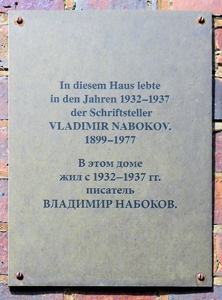
Nabokov wrote about how Berlin struck his refined eye, with its ubiquitous trains, its shop windows, and its postcard sellers under the Brandenburg Gate and its comic rooftop statues, and how anything can become material to rebuild a private, redemptive Eden of the mind. Beneath his old flat in the Nestorstrasse there's now a pub calling itself Die kleine Weltlaterne — The Little Lantern of the World. Not a bad coincidence.
He came out of a time which could not contemplate the collapse of life as an aesthetic paradise for the few. Yet collapse it did. In Penguin's sumptuous new Nabokov Library, we can return to that paradise lost.


9:07 PM
4:06 PM
5:06 PM
4:06 PM