



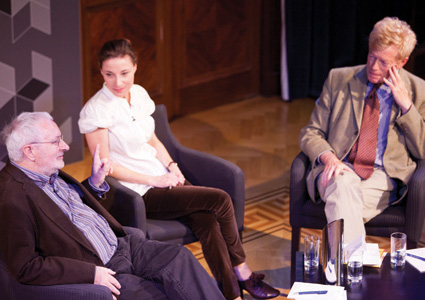
Terry Eagleton and Roger Scruton, moderated by Hannah Kaye, at an Intelligence Squared debate in 2012 (©Intelligence Squared/Tim Bowditch)
It’s odd to realise that our two most powerful and prolific rivals in Kulturkritik were fellow-students of Jesus together, and seem now to be, in a philosophical way, cousins in Christ. Sir Roger Scruton and Terry Eagleton knew each other at Jesus College, Cambridge, have pursued parallel intellectual careers, and have adopted the engaging roles of lion and unicorn fighting for the Kulturkritiker’s crown. Neither has won it outright, partly because they have both been politically controversial, but readers could always enjoy and learn much from a unique double act, especially after Eagleton had begun to emerge from heavy Marxist ideology, reject mere materialism, and come out to skirmish with Scruton more on his own rather well-clipped turf, rather than launching all his salvoes from the muddied Marxist trenches.
The German term is right because the tradition in which they have both worked originates in the Aufklarung, and means thinkers and theorists rather than critic-essayists. Their work is as much a question of serious aesthetics as of politics, but if one doubts the intimate connection between these, a journey through Scrugletopia, now mapped out in about a hundred books, should clarify matters. Scruton built deep foundations as a philosopher of aesthetics, so let’s start there.
He reissued his second book, The Aesthetics of Architecture, in 2013. This, “the most important contribution to its subject since Ruskin” according to David Watkin, starts with the “first philosopher to suggest that the sense of beauty is a distinct . . . employment of the mind comparable to moral and scientific understanding” (Kant); but Scruton went further, to “demonstrate that the division between practical reason and aesthetic understanding is in fact untenable, and that until the relation between the two is re-established they must both remain impoverished”. He rejects merely utilitarian, empiricist or individualistic concepts, deriving a fuller concept of self-realisation from Hegel, which is achievable only within a web of social relations: this concept remains vital to him.
His illuminating arguments help readers to rationalise views held reasonably but not philosophically. He believes that “ugliness kills, and we should plan to avoid it”; that “aesthetic values are all-important: they are advocates of our long-term interests in the court of our present desires”; and, crucially, that there is “some core of aesthetic constants to which human nature is attuned”, and that “aesthetic judgement is closely related to moral judgement” — that no matter how hard it might be to gain agreement on how it is so, there are objective standards (Many agree, but neither he nor anyone else, to my limited knowledge, has been able to argue a definitive case, let alone prove it).
Such themes predominate: in The Aesthetics of Music (1997), one of the most ambitious studies of its type, he says, “We encounter works of art as perfected icons of our felt potential, and appropriate them in order to bring form, lucidity and self-knowledge to our inner life.” His approach is rationally subjective at times, almost in the manner of Montaigne, for he argues that we can find true freedom in music — the “transcendental unity” of our selves — a characteristic phrase; and that we enter thereby a “dance of sympathy” with others. Like Plato, he sees music as a maker and yardstick of a culture’s moral character. Later on, he convincingly attacks atonality (“the mere existence of a serial order . . . does nothing to prove that it is a musical order, or that it is the order that we hear, when we hear the music”). Here, and in Understanding Music (2009), he achieves elements of the impossible task of explaining how great music creates its mysterious meanings.
Like this article? Share, save or print using the icons below:


- The inevitability of Fortress Europe
- The way forward for Europe’s great outsider
- The devout sceptic: hope for those of little faith
- Corbyn waves the flag of anti-Semitism
- In Corbyn’s mind, there is no place for the Jews
- Corbyn's road map to a communist Britain
- Is the mental illness epidemic just a myth?
- Viennese rooms with a point of view
5:07 PM
9:07 AM
9:07 AM
12:07 PM