


Among art historians, T.J. Clark made his name as a radical outsider. Once a member of the Situationist International, he has since preferred to follow his own peculiar path. This he did at Berkeley as a professor of modern art, until his recent retirement. He has been more an essayist around art than a scholar of art. Indeed, he is almost as well known in English departments as he is in art history departments. He also writes poetry; he has escaped from academia and become a literary figure. Now he takes on Picasso. He finds that most writing on the artist has been "abominable". It tends to "gossip or hero-worship". So he will talk about Picasso's actual work — Picasso and Truth (Princeton, £25.95) prints a series of lectures given at the National Gallery of Art, Washington — avoiding biography as much as possible.
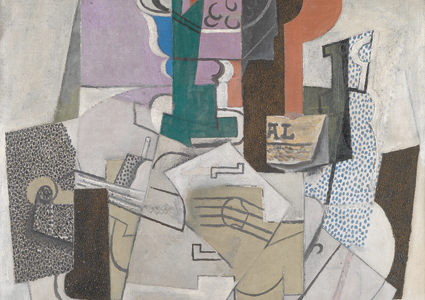 Ironical cant: Detail from "Fruit Dish, Battle and Violin" (1914) by Pablo Picasso
Clark is obviously enthralled by Picasso's paintings, and he has thought long and hard about them. His enthusiasm draws him into the details, every one of which he likes to describe, but he manages to keep sight of the grand narrative too: the development of Picasso's representations of space up to Guernica.
The book is impressively illustrated. Its generous reproductions trace Picasso's enquiry, making its original energy so apparent that even the most familiar pictures seem fresh again. At the same time these reproductions usefully remind us that Picasso's progress was often rigorous and even slow. The very layout of the book, then, quells the lazy temptation to think of Picasso as a blustering genius forever following his fancy. And the bigger problem of whether Picasso's disparate works live up to his giant artistic promise is indirectly addressed, as Clark's arguments always return to rest on a handful of Picasso's grandest works.
We see how, having explored all the possibilities of a new style, Picasso summed up in these larger, denser, most ambitious paintings which were probably always intended for the museums. However, it is still difficult to think of Picasso as a painter of masterpieces. Picasso's art must be as much between his pictures as in them — how are we to understand a Cubist painting on its own? Therefore Picasso's art remains inseparable from his extraordinary career, and our knowledge of it. Perhaps that is another reason — apart from the fact that Picasso almost insisted on his art being treated as an anthropological document — why critics retreat into biography. Clark may have resisted restating the gossip but, though he wishes to deal directly with the painting, he cannot avoid navigating from canvas to canvas and weaving his narrative around what is supposed to be the artist's lifelong project.


- Online Only: The Price Paid for Criticising Islam
- Is Islam a Peaceful Religion? Daniel Johnson at the Oxford Union
- Birthrate of a Nation
- The Beeb Needs its Mavericks
- Is a Stradivarius Just a Fiddle?
- Online Only: Heirs to the Left
- 'Please Sir, I Just Want to Learn More'
- A 'Liberal Racist'? Me? I Felt Like a Heretic
12:07 PM
10:07 PM
2:07 AM
11:07 AM
10:07 PM
1:07 PM