
You are here:   Civilisation >  Critique > The Loss Of Faith Made Music Mute
 

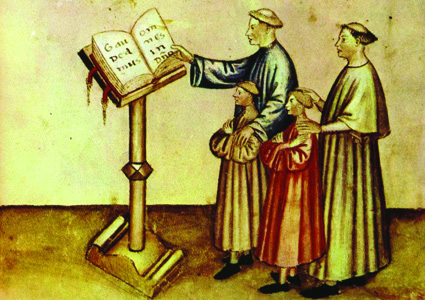
Church music: Seen here in the medieval treatise "Tacuinam Sanitatis", it forged the basis of classical music

It is a mystery to many people why so few contemporary classical composers seem capable of writing "a good tune". Surely, given the number of students who pursue composition in our universities and conservatoires, and the hugely increased access which technologies such as music-notation software give to prospective composers, we should expect to find at least one or two capable of making a popular impact? Why is it that, with more people than ever engaged in the activity of composing, our culture still seems incapable of fostering a contemporary Verdi or Stravinsky, with the celebrity and popular recognition that such great figures once garnered?

It is certainly true, as Simon Heffer has amusingly put it in Standpoint ("A Raspberry for Emetic Music", November 2014), that the musical establishment is "in hock to the crap merchants" and in thrall to the state, creating a tyrannical orthodoxy of ugliness, admission to which can only be gained by imitating the style of "orchestrated raspberries" currently in vogue. However, the underlying cause—though closely related to the over-reaching influence of the modern state—ultimately goes far deeper than this. To understand the deficit of successful contemporary classical music, what we need to uncover are the feelings which motivated the artistic instincts of the great composers of the past, but which are now absent in the minds of modern composers, thus accounting for their "emetic" output.  

In the year 1900, the following composers were alive, and the majority of them active: Saint-Saëns, Debussy, Ravel, Stravinsky, Rimsky-Korsakov, Rachmaninoff, Prokofiev, Bartók, Elgar, Vaughan Williams, Holst, Mahler, Strauss, Sibelius, Grieg, Puccini, Dvořák and Janáček. This list of exalted and well-known figures is far from exhaustive, and should give us pause. We cannot possibly pretend that the world today can boast a similar number or calibre of composers; indeed, any one of these figures is of far more interest to most of us than any of today's most famous composers. Moreover, if one expands this categorisation to include any composer active between the years 1850 and 1950, one possesses pretty much a complete list of the works in the standard orchestral repertoire (save the old German masters), and hence those pieces which one would find overwhelmingly on offer in any events guide produced by today's professional orchestras.

On closer inspection, it is not hard to see the idée fixe that unites this vast array of varied talent: nationalism. To varying degrees of explicitness, whether through the deliberate inclusion of folk elements, or simply a general over-arching style suggestive of national sentiment, all of these figures would quite happily have thought of themselves, not just as composers, but as French, Russian, Hungarian, English, German, Finnish, Norwegian, Italian or Czech composers. It is in fact a statement of the obvious to point out that the feelings that underpin a good deal of what these composers set out to accomplish was driven by a passion for the language, history, customs, traditions, institutions and, perhaps most prominently, the countryside of their native lands.

This surge of nationalist output, produced during the long 19th century, was an obvious accompaniment to the growth of the nation state itself. However, there is another deeper set of convictions which the classical composers held in common, and upon which the nation states of Europe themselves were predicated: Christianity.

View Full Article
 
Share/Save


amcdonald
March 24th, 2015
4:03 PM
Angela Ellis- Jones thinks the production and consumption of classical music requires intellect; trashy pop music requires little. What about great pop music? Classical music is essentially for bores, it`s a shrinking market updated by `sampling` in pop and film music. Ellis-Jones appears to regret the rise of the capitalism of `the people`. She speaks classical music `Stalinism`. It requires no intellect at all.

GMcK
March 22nd, 2015
5:03 AM
This article made me laugh out loud - its author is so out of touch with what's happening in the music world today. Like me, he probably hasn't bought a new album since 2002, but I at least read the concerts section in the paper. There are entire realms of music using symphony orchestras that are totally missing from his so-called "classical music" genre. If you want tonal music with "meaning" you need go no further than your Netflix subscription, where the works of Bernard Herrmann and Max Steiner and Erich Wolfgang Korngold should satisfy your cravings, and recently works from John Williams and Howard Shore are filling up concert halls with live performances the world over. "Serious" composers like John Adams continue to cause scandals in cosmopolitan centers like New York. As that religion guy once said, "he who has ears to hear, let him hear."

angela ellis-jones
March 21st, 2015
12:03 PM
Is it the decline of Christianity or the rise of mass democracy that is to blame for the loss of classical music? ~The latter was the music of the aristocracy and the bourgeoisie;when 'the people' came into their own post-1945,their cacophonous sounds ruled the airwaves.The production and comsumption of classical music requires intellect;trashy pop music requires little.

Jerry Baustian
March 21st, 2015
4:03 AM
The author fails to notice that there is a tremendous amount of symphonic and chamber music being written and listened to today -- it is written as the sound tracks to films. Individually, some of the works by John Williams, Alexander Desplat, Howard Shore, Hans Zimmer, James Horner, James Newton Howard, Thomas Newman, Danny Elfman, and Patrick Doyle are as interesting and listenable as anything produced from 1850 to 1950. And in the previous generation there were Elmer Bernstein, Jerry Goldsmith, John Barry, Maurice Jarre, Ennio Morricone, Bernard Herrmann, Alfred Newman, and so many others. Serious composers in the 18th and 19th centuries wrote operas. Today they write for the cinema. Musical enthusiasts then and now seem to like a visual element. If you still think music is dying, then ask yourself whether you'd enjoy your favorite movies if there was no musical score. The best films today have the best original scores, and the best of those scores can stand alone in a concert hall.

Bruce McNeill
March 15th, 2015
10:03 PM
There is still a lot of good classical music to listen to even though there is little modern compostion, enough even to see anybody out.

John V. Linton
March 12th, 2015
1:03 PM
This is quite interesting, but I'm quite surprised the author doesn't more fully acknowledge an alternate hypothesis: That of thematic exhaustion of tonal musical content by all those diligent Germans. It seems far more plausible to me (see Stephen Jay Gould) that this accounts for the paucity of modern-day Beethovens.

Efflorescent
March 10th, 2015
2:03 AM
I appreciate the article writer's aim, but the argument is erroneous. For a start, if we agree the era of classical music's greatest creativity was 1850-1950, we must acknowledge that this period is AFTER the church's social dominance had begun to decline. Harmonic techniques which admittedly had origins in Renaissance church music were now largely used for secular purposes. Also, naming a couple of operas with Christian themes is to overlook that most operas were NOT concerned with propounding Christian dogma. Wagner, for instance, was at least equally interested in reviving pagan mysticism. Nationalism was important in encouraging outlying regions of Europe to develop culturally, and bringing new musical flavours to light, but was not a prime cause; the earlier German composers (among others) had employed folk rhythms and melodies without the impulse of nationalist chauvinism. I think the big disaster that affected classical music was the rise of Modernism, with its mindset that radical innovation and conforming to certain obscurantist dogmas were more important than valuing artistic traditions and attempting to communicate with listeners. Some modern composers have attempted to return to these older values, but make the mistake of trying to do this through the language of recent mediocrities rather than starting from the old masters.

Jimbob
March 7th, 2015
12:03 AM
This article makes some good points, but I don't know if I can follow it along to the conclusion. I do think that the rise of "art for art's sake", which at one time must have seemed liberating, has instead led to a mostly barren and stifling insularity. So much music seems to exist only to comment on other music--most of which is unknown to the public, creating an ever deepening spiral of obscurity. Or it drily works out variations on some musical idea with no real sense of direction. On the other hand, there's still plenty of music that attempts to comment on something other than itself--see last year's Pulitzer prize winner in the USA, a piece by John Luther Adams inspired by rising ocean levels. I don't think the overall thesis holds up. Are Edward Gregson and Kenneth Hesketh household names? If the author were right, Messiaen, whose music is profoundly spiritual, should be as well-known as Brahms.

amcdonald
March 6th, 2015
9:03 PM
To Pete Byrne`s "irrelevant" I would add twee and quaint. Popular culture has more to say about faith,atheism,misotheism and creation sacred and profane. Kraftwerk,The Revolutionary Army of the Infant Jesus, Heart`s female version of Led Zep`s `Kashmir` (live with Led Zep and President Obama in the audience)are all on Youtube. God must have abandoned official Christian music when it invented `Christian-rock` . His grace is bestowed elsewhere. Not much sign of it in anti-bohemian Islam either. Decadence and nihilism are also forms of mysticism. Decadence in the history of art is a classical category and part of the creative cycle in the rise and fall of empires. A pistol to the head or the foot of the Cross was the critics advice to Huysmans for his book `Against Nature`. To be stuck in the 20th century is the fate of many artists and musicians.

Pete ByrneAnonymous
March 5th, 2015
9:03 PM
The zeitgeist changes and music changes. Classical music has simply become irrelevant in light of the world as it's lived in.

Post your comment

CAPTCHA
This question is for testing whether you are a human visitor and to prevent automated spam submissions.