



The second, and more significant, consequence of the move to Lausanne was that it liberated Gibbon's mind and made him "intellectually not an Englishman at all". This un-English dimension was important to Trevor-Roper's view of Gibbon, not simply because he took pleasure in the smiting of all parochialisms, but because it corroborated his interpretation of the Decline and Fall as a European work which merely happened to be written in English. He liked to remind his audiences and his readers of the fact that Gibbon had originally intended to write his history in French, before being dissuaded from doing so by David Hume.
In a series of articles, Trevor-Roper restated and repolished what was essentially a single argument designed to restore to view what he saw as the obscured intellectual complexity and richness of the Decline and Fall. He would typically begin by drawing out the significance of Gibbon's immersion in the intellectual currents of the European enlightenment during his exile in Lausanne. Two influences had been salient, the first of which had supplied Gibbon with his problem, the second with his method. On the one hand, that Neapolitan martyr to papal oppression, Giannone, had led Gibbon towards an awareness that the subject of the decline and fall of the Roman empire was the greatest historical problem thrown up by the Enlightenment, because of the challenge it seemed to pose to the Enlightenment's darling doctrine of progress. On the other, Montesquieu had released Gibbon from the pulverising Pyrrhonism of Bayle and Voltaire, had oriented his stance on matters of religion away from sterile questions of doctrinal truth or falsehood, and had encouraged him to view religion through the lens of social function.
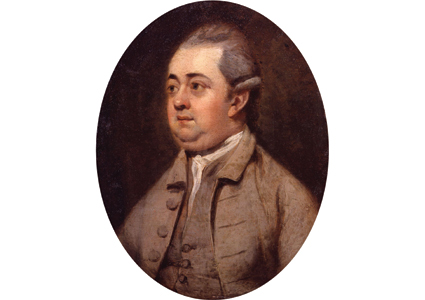
Apostle of open society: Edward Gibbon by Henry Walton
Trevor-Roper illustrated Gibbon's engagement with Giannone's problem by underlining the Decline and Fall's commitment to the view that civilisation was safe and human progress could not be undone because Western Europe was not vulnerable to calamitous change in the manner of the Roman Empire. This interpretation of the Decline and Fall as at root an anti-imperial work which described and celebrated how the 18th-century European republic of Christian monarchies had taken wing from the ashes of despotic antiquity has much to be said for it. Trevor-Roper was fond of recommending it by drawing attention to Gibbon's plurality of values, his hatred of "immobilisation", his commitment to "the free circulation of goods and ideas", and his preference for open, rather than closed societies — characteristics illustrated typically by a contrast drawn with Voltaire, by Gibbon's censure of monasticism in the Decline and Fall, and by his insistence to Lord Sheffield that his library should be broken up and sold after his death, on the grounds that he was "a friend to the circulation of property of every kind".
A different passage of the Decline and Fall was repeatedly used to show that, notwithstanding the hysterical response to the notorious "two chapters", which concluded the first volume of the Decline and Fall, when he contemplated religion Gibbon was indeed a follower of Montesquieu, rather than a disciple of Voltaire. Here Trevor-Roper showed impeccable taste. The passage to which he gravitated was the final section of chapter 54, perhaps the most brilliant chapter in the entire history, which traces the fortunes of the obscure Byzantine sect of the Paulicians, before broadening to offer in little more than 1,000 words an extraordinary account of the progress of Christianity in Europe since the Reformation. Trevor-Roper particularly relished Gibbon's challenge to the Reformers' self-image as the liberators of the minds of men from the spurious doctrines of Roman Catholicism, notably transubstantiation.
For, as Gibbon had acutely noted:
...the loss of one mystery was amply compensated by the stupendous doctrines of original sin, redemption, faith, grace, and predestination, which have been strained from the epistles of St Paul. These subtle questions had most assuredly been prepared by the fathers and schoolmen; but the final improvement and popular use may be attributed to the first reformers, who enforced them as the absolute and essential terms of salvation. Hitherto the weight of supernatural belief inclines against the Protestants; and many a sober Christian would rather admit that a wafer is God, than that God is a cruel and capricious tyrant.


11:05 AM