


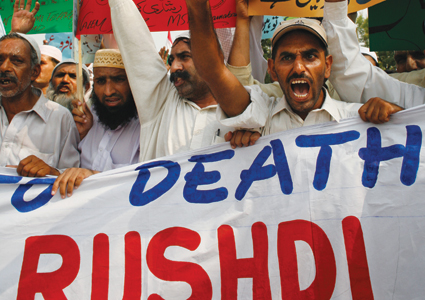
 Protest, Islamabad, 2007: The Rushdie test tells you all you need to know about a writer’s willingness to choose freedom or brute power
No group is better than liberal academics at illustrating how racist anti-racism has become. As liberals, they ought to respect individual rights and oppose reactionary attempts to corral and control. As academics, they ought to look for evidence that shakes comfortable opinions. As it is, they do neither.
In human rights organisations, leftish political parties, liberal newspapers and, above all, in the universities, committed and morally earnest people would rather die than admit that radical Islam is a murderous and oppressive movement. The effect of their evasion is to promote the racism they say they oppose, while denying their supposed allies in "Muslim lands" and immigrant communities the same rights as they enjoy. Hypocrisy is too meagre a word to cover their behaviour.
Take the latest effort to land in my pigeonhole: On the Muslim Question by Anne Norton, a professor of political science at Pennsylvania University. Norton's publishers, Princeton University Press, modestly declare that she is a "fearless, original and surprising" author. In truth she is timid, unthinking and hackneyed. Like thousands of her contemporaries, Norton argues that conservative elites in the West use radical Islam to befuddle the doltish masses. There is truth in the charge that ever since 9/11 security services have taken the opportunity to bring in excessive coercive powers to fight the menace of Islamist violence. If that were the end of the argument, I could not object. Norton is a typical representative of the Anglo-American intelligentsia because she goes on to pretend that there is no real menace, and to cover up the mistreatment of women, the suppression of free speech, the inquisitorial punishment of heresy, and all the other woes armed and militant religion brings.
As with everyone of my generation (I was born in 1961), the "Rushdie test" tells you all you need to know about a political writer's willingness to choose freedom or brute power. Norton fails it, and seems to me to want to fail it. She tells us that Ayatollah Khomeini's fatwa against Salman Rushdie, was a "very local fuss" and a "very British affair" — as bland and unthreatening as a walk in the park. She assures the reader without caveat or elaboration that "no arrests or injuries occurred as a result of the demonstrations" against Rushdie. Even as a description of the formal demonstrations against The Satanic Verses that isn't true — the police arrested 84 people as they hung effigies of Rushdie outside Parliament in May 1989. But formal demonstrations were not the end of the protests, as she must know. Norton does not tell the reader how the supporters of religious reaction murdered or attempted to murder Rushdie's translators, staged riots in which dozens died in Bangladesh, Pakistan and Turkey, and bombed bookshops in central London and the US for stocking copies of the blasphemous novel.


- Admit It, Mr Kerry: You Blundered
- Bismarck Versus Blair — A Foreign Policy Crossroads
- Arab Spring, Islamist Summer — What Next?
- The Diplomat the Whole World Ignores
- The Blob Has Run Schools For Decades. Not Any More
- Would You Intervene — Or Pass On The Other Side?
- He Died That Others Might Live In Peace
- The Hero's Journey is Hollywood's McMyth
- Online Only: Countering the Counter-Jihadists
- Online Only: The Price Paid for Criticising Islam
- 'Please Sir, I Just Want to Learn More'
- Why Students Should Be Glad To Pay Tuition Fees
- A 'Liberal Racist'? Me? I Felt Like a Heretic
- Demolish the Relics of Yesterday's Future
- Was Britain Right To Go To War In 1914?
- German Victorians Who Helped Transform Britain
- The Alternative History of an Undivided India
- Online Only: Heirs to the Left
- ONLINE ONLY: The Hayward Gallery's Fashionable Primitives
- ONLINE ONLY: A Spiritual Corner of Southwark

- The Zombie Argument that Refuses to Die
- Online Only: The Price Paid for Criticising Islam
- Overrated: Dan Brown
- Overrated: George Monbiot
- Is the Brain the Key to Understanding Religion?
- 'Please Sir, I Just Want to Learn More'
- An Assault on Free Speech at the LSE
- The Alternative History of an Undivided India
- The Zombie Argument that Refuses to Die
- Online Only: The Price Paid for Criticising Islam
- Overrated: Dan Brown
- Overrated: George Monbiot
- Is the Brain the Key to Understanding Religion?
- 'Please Sir, I Just Want to Learn More'
- An Assault on Free Speech at the LSE
- The Alternative History of an Undivided India
- Decline and Fall of the History Men
- Uncritical Theorists Who Misread the Nazis
- The Zombie Argument that Refuses to Die
- The Banality of Hannah Arendt
- From Kitsch to Cool: Picasso and Modern Art
- Is the Brain the Key to Understanding Religion?
- Time to Wise Up to the Muslim Brotherhood
- Midfield Virtuoso Finds His Perfect Pitch
- Online Only: The Price Paid for Criticising Islam
- Overrated: George Monbiot
- Letter from Ukraine: Reviving Lost Literature
- On Pilgrimage with the Hasids
- Tsar Of The Holy Land
- The Blob Has Run Schools For Decades. Not Any More
- Bismarck Versus Blair — A Foreign Policy Crossroads
- My Dieting Guide: Listen To Mother
5:05 PM
9:04 AM
11:03 PM
4:03 PM
4:03 AM
3:03 AM