


In January 1979, at the height of the "Winter of Discontent", the British Prime Minister Jim Callaghan was interviewed as he disembarked at Heathrow. Asked about the strikes that had even left the dead unburied, Callaghan replied: "I don't think other people in the world would share the view that there is mounting chaos." This was summarised by the Sun in a memorable tabloid headline: "Crisis? What Crisis?" Two months later, Callaghan lost a motion of no confidence in the House of Commons, and in the subsequent election Margaret Thatcher swept to power. The moral of the story is: faced with a crisis, the one thing a leader cannot afford to show is complacency.
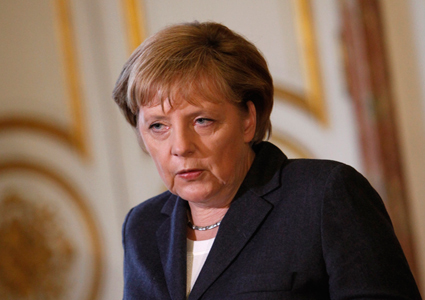
Angela Merkel has acknowledged the real threat to the West
I want to ask what we might call Callaghan's question: what crisis? What kind of crisis are we talking about? Is this present crisis really a crisis of capitalism? Or is it, rather, a crisis of the Western civilisation to which capitalism belongs? Until the rise of socialism, the market economy functioned more or less well. Then Marx renamed the market economy "capitalism" and insisted that it was inevitably destined for "crisis". This was good news for economists, particularly those of the Left, because their diagnostic and prescriptive expertise was thereby rendered indispensable — indeed, permanently so. According to the experts, therefore, capitalism has been in crisis more or less ever since. We have all got so used to this terminological conjunction that to our ears, "capitalism" and "crisis" belong together, like "in the long run" and "we are all dead".
Is it the case, as Marx believed, that economics determines politics and culture, or isn't the reverse true: that the predicament we face is primarily a cultural and political phenomenon, of which the economic upheaval is merely an epiphenomenon?
My answer is that the economic problems we face are serious but soluble and certainly not systemic. In fact, the market's self-correcting mechanisms have already gone a long way to restoring equilibrium. The main contribution that governments can make is to live within their means, to maintain the money supply and to resist populist demands for punitive taxation or regulation. And, for the most part, these are indeed the measures that they are taking, in the teeth of often violent opposition.
But that is not the whole story. Underlying the present fluctuations in the financial and labour markets is a challenge to our fundamental values as a civilisation. It is this threat to Western civilisation that truly merits the appellation "crisis". The economic turmoil has the function of highlighting the stark choice that we will have to make, and on which will depend the future of our civilisation.


- Admit It, Mr Kerry: You Blundered
- Bismarck Versus Blair — A Foreign Policy Crossroads
- Arab Spring, Islamist Summer — What Next?
- The Diplomat the Whole World Ignores
- The Blob Has Run Schools For Decades. Not Any More
- Would You Intervene — Or Pass On The Other Side?
- He Died That Others Might Live In Peace
- The Hero's Journey is Hollywood's McMyth
- Online Only: Countering the Counter-Jihadists
- Online Only: The Price Paid for Criticising Islam
- 'Please Sir, I Just Want to Learn More'
- Why Students Should Be Glad To Pay Tuition Fees
- A 'Liberal Racist'? Me? I Felt Like a Heretic
- Demolish the Relics of Yesterday's Future
- Was Britain Right To Go To War In 1914?
- German Victorians Who Helped Transform Britain
- The Alternative History of an Undivided India
- Online Only: Heirs to the Left
- ONLINE ONLY: The Hayward Gallery's Fashionable Primitives
- ONLINE ONLY: A Spiritual Corner of Southwark

- The Zombie Argument that Refuses to Die
- Online Only: The Price Paid for Criticising Islam
- Overrated: Dan Brown
- Overrated: George Monbiot
- Is the Brain the Key to Understanding Religion?
- 'Please Sir, I Just Want to Learn More'
- An Assault on Free Speech at the LSE
- The Alternative History of an Undivided India
- The Zombie Argument that Refuses to Die
- Online Only: The Price Paid for Criticising Islam
- Overrated: Dan Brown
- Overrated: George Monbiot
- Is the Brain the Key to Understanding Religion?
- 'Please Sir, I Just Want to Learn More'
- An Assault on Free Speech at the LSE
- The Alternative History of an Undivided India
- Decline and Fall of the History Men
- Uncritical Theorists Who Misread the Nazis
- The Zombie Argument that Refuses to Die
- The Banality of Hannah Arendt
- From Kitsch to Cool: Picasso and Modern Art
- Is the Brain the Key to Understanding Religion?
- Time to Wise Up to the Muslim Brotherhood
- Midfield Virtuoso Finds His Perfect Pitch
- Online Only: The Price Paid for Criticising Islam
- Overrated: George Monbiot
- Letter from Ukraine: Reviving Lost Literature
- On Pilgrimage with the Hasids
- The Blob Has Run Schools For Decades. Not Any More
- Tsar Of The Holy Land
- Bismarck Versus Blair — A Foreign Policy Crossroads
- My Dieting Guide: Listen To Mother
3:12 PM
7:12 PM
4:12 PM
12:11 PM
5:11 PM
5:11 PM