


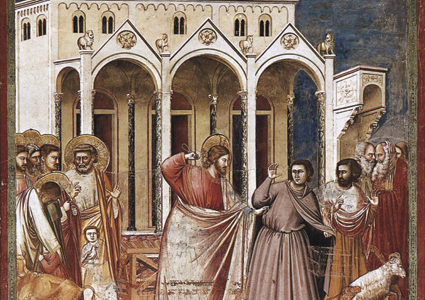
Tensions in the Temple: "Expulsion of the money-changers" by Giotto, c.1304
The combined expression "Jewish Christian", made up of two seemingly contradictory concepts, must strike readers not specially trained in theology or religious history as an oxymoron. For how can someone simultaneously be a follower of both Moses and Jesus? Yet at the beginning of the Christian movement, in the first hundred years of the post-Jesus era, encounters with Jewish Christians distinguishable from Gentile Christians were a daily occurrence both in the Holy Land and in the diaspora.
To understand the genesis of these notions, the first point to note is that during his days of preaching, Jesus of Nazareth addressed only Jews, "the lost sheep of Israel" (Mt 10:5; 15:24). His disciples were even expressly instructed not to approach Gentiles or Samaritans (Mt 10:5). On the few occasions that Jesus ventured beyond the boundaries of his homeland, he never proclaimed his gospel to pagans, nor did his disciples do so during his lifetime. The mission of the 11 apostles to "all the nations" (Mt 28:19) is a "post-Resurrection" idea. It appears to be of Pauline inspiration and is nowhere found in the Gospels apart from the spurious longer ending of Mark (Mk 16:15), which is missing from all the older manuscripts. Jesus's own perspective was exclusively Jewish; he was concerned only with Jews.
Indeed, we learn from the Acts of the Apostles that the primitive community of Jesus followers consisted of 120 Jewish persons, including the 11 apostles and the mother and brothers of Jesus (Acts 1:14-5). This is incidentally the last reference to Mary in the New Testament, although there are further allusions to the male siblings of Jesus in the Acts and in Paul. James, "the brother of the Lord" as Paul refers to him, is presented as the leader of the Jerusalem church (Acts 15:19; Gal 1:19) and according to another Pauline passage, the married brothers of Jesus also acted as missionaries of the Gospel (1 Cor 9:5).


- How Jeremy Corbyn's Coup Hijacked Labour
- Corbyn's Signpost Back To The Ghetto
- Unionists, Don't Despair: Scotland Is Not Lost — Yet
- Britain's Apologists For Child Abuse
- Lift The Fee Cap And Set Universities Free
- The Story Behind One Dead Man's Penny
- Hitler's 'Ecological Panic' Didn't Cause The Holocaust
- Meet The Montalvos: The First Global Family
- Mr Gove, Here Is Our Statute of Liberty
- A British Bill Of Rights
- Something For Nothing Just Won't Do Any More
- Ditch Ed Miliband's Crazy Energy Legacy
- The English Public School: An Apologia
- An Open Letter To Nicky Morgan
- Escape The Heat: Head To London's Crow's Nests
- Collusion Cut Both Ways In The Troubles
- Decline Of The East? The Chinese Say No
- Conservative, Moi? Jamais De La Vie!
- How To Rescue Iraq From Obama's Folly
- Europe Must Never Again Betray Its Jews

11:11 PM
5:11 PM