



Measuring output at current prices and exchange rates suffers from several flaws. It can be misleading, particularly if judgments are being made about relative living standards. Haircuts and taxi journeys are much the same all over the world, but their value in countries with limited export capability is recorded at a much lower figure than in countries that are export champions. A further and well-recognised weakness is that exchange rates can move erratically in response to temporary and reversible changes in market conditions for a nation’s exports and imports. Russia suffers from this difficulty at present, because it is a major energy exporter, and the prices of oil and gas are depressed.
An alternative approach is to calculate national outputs at so-called “purchasing power parity”. The idea is easy enough in principle. The average Russian citizen may have a much lower income, when translated into dollars, than the average American, and could not on that income pay at all for a taxi journey or afford a decent haircut in the US. But — because prices in roubles in Russia are much less — he can comfortably afford the occasional taxi and a smart haircut in his own country. As it happens, both the World Bank and the International Monetary Fund conduct research into these awkward measurement issues. Indeed, the IMF regularly publishes data on its members’ share of world output, where output is measured (or perhaps one should say guesstimated) on a purchasing-power-parity basis.
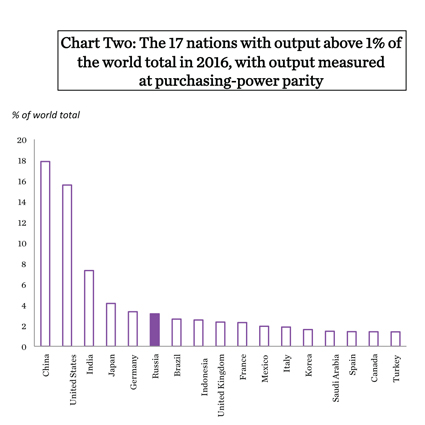
Forecast numbers for 2016 are available, and are incorporated in Chart Two. With PPP-adjusted data, 17 nations have output that exceeds 1 per cent of the global total. The nations do not overlap precisely in our two charts, which shows how difficult the subject can be. A salient message is that Russia is much more important with this different method of calculation. Whereas it accounts for about 1.75 per cent of world output on a current-price-and-exchange-rate basis, the figure is 3 per cent on a PPP basis. It ranks 13th in the world on the former approach, but sixth on the latter.
But does that make it a great power? Can a particular state swagger around and puff itself up relative to the rest of the world if the rest of the world produces more than 30 times as much as it does? And is not this sort of bravura rather odd, when we remember that its relative economic position is flattered by a generous estimate of the value of domestic service production, including such items as haircuts and taxi journeys? Of course, there is ample scope for debate about the merits of the various methods of measuring different nations’ income and output. But it should be emphasised that, on the most favourable possible interpretation, Russia in the early 21st century is no more than a medium-weight power in economic terms.
An alternative approach is to calculate national outputs at so-called “purchasing power parity”. The idea is easy enough in principle. The average Russian citizen may have a much lower income, when translated into dollars, than the average American, and could not on that income pay at all for a taxi journey or afford a decent haircut in the US. But — because prices in roubles in Russia are much less — he can comfortably afford the occasional taxi and a smart haircut in his own country. As it happens, both the World Bank and the International Monetary Fund conduct research into these awkward measurement issues. Indeed, the IMF regularly publishes data on its members’ share of world output, where output is measured (or perhaps one should say guesstimated) on a purchasing-power-parity basis.
Forecast numbers for 2016 are available, and are incorporated in Chart Two. With PPP-adjusted data, 17 nations have output that exceeds 1 per cent of the global total. The nations do not overlap precisely in our two charts, which shows how difficult the subject can be. A salient message is that Russia is much more important with this different method of calculation. Whereas it accounts for about 1.75 per cent of world output on a current-price-and-exchange-rate basis, the figure is 3 per cent on a PPP basis. It ranks 13th in the world on the former approach, but sixth on the latter.
But does that make it a great power? Can a particular state swagger around and puff itself up relative to the rest of the world if the rest of the world produces more than 30 times as much as it does? And is not this sort of bravura rather odd, when we remember that its relative economic position is flattered by a generous estimate of the value of domestic service production, including such items as haircuts and taxi journeys? Of course, there is ample scope for debate about the merits of the various methods of measuring different nations’ income and output. But it should be emphasised that, on the most favourable possible interpretation, Russia in the early 21st century is no more than a medium-weight power in economic terms.
Like this article? Share, save or print using the icons below:


More Features
- We Need Churchill's Vison of Liberty More Than Ever
- The Play's The Thing, So Leave The Words Alone
- An Aesthetic and Moral Disaster
- How we Syrians destroyed our home — with your help
- Euphoric Labour won’t win power led by a pied piper
- Don’t be ‘difficult’ — try ‘formidable’, Mrs May
- Enough is enough of terror — but also of our self-doubt
- Iraq’s Christians pray for help that never comes
- The Atlantic alliance may be broken beyond repair
- Catholic tastes: both English and European
- Brexit as myth: Exodus, Reckoning, or Sacrifice?
- A Decent Woman Betrayed By Her Gruesome Twosome
- Can Macron Save France — Or Is He Its Undertaker?
- Europe's Revival Is At Hand, Thanks To Brexit
- Is This The Most Important British General Election Since 1979?
- The New Europe Must Be About More Than Money
- Our Best Brexit Policy Is All-Out Free Trade
- The Bursting Of Our 'Kabubble' Fantasies
- Gambling On A Greater More Gracious Britain
- Xi Versus Trump: The Emperor And The Tycoon
Popular Standpoint topics

- Cultural Climate Change
- Opposites meet in the land of Scrugletopia
- The Battle Against The Philistines Never Ceases
- Can Macron Save France — Or Is He Its Undertaker?
- Home from home for the Bolshevik elite
- Why France Is Revolting Against The Ancien Regime
- How The EU Elite Paved The Way For Populism
- A Decent Woman Betrayed By Her Gruesome Twosome
2:03 PM
4:03 PM
5:03 PM
4:03 PM
4:03 PM
9:03 AM
4:03 AM
3:02 PM
6:01 PM
5:12 PM