


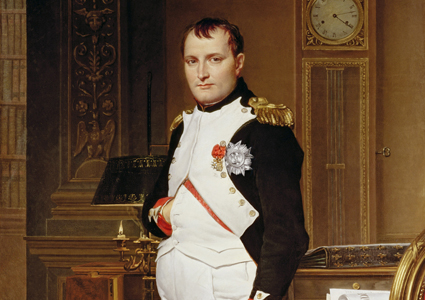
 Object of mockery: Jacques-Louis David’s portrait of Napoleon
When Winston Churchill appointed R.A. Butler as the president of the Board of Education in 1941, he advised him: "I should not object if you could introduce a note of patriotism in our schools. Tell the children that Wolfe won Quebec." Butler believed it would be too autocratic to dictate to schools what lessons they should teach, and it was not until 1988 that Kenneth Baker imposed a national curriculum on Britain's state schools.
Since the arrival of the national curriculum, public debate on school history has focused almost exclusively on what topics should be taught, namely whether the emphasis should be on British or world history. This debate has been fuelled by a steady stream of surveys revealing the ignorance of today's school-leavers. One commissioned last summer by Lord Ashcroft found that while 92 per cent of 11- to 18-year-olds could identify the animated dog from the car insurance advertisements as Churchill, only 62 per cent could identify a photograph of Britain's wartime prime minister. Fewer than half knew that the Battle of Britain took place in the sky.
However, having become a history teacher at a state secondary school two years ago, I have realised that such debates miss the real problem. I was surprised to learn that since its inception the national curriculum has stipulated a sensible split of British and world history: every pupil between the ages of 11 and 14 is expected to study a chronological sweep of British history from 1066 to the present day. To understand the degradation of history teaching, one has to focus not on what history is taught, but how it is taught.
I was inspired to become a teacher by a desire to emulate two history teachers I was fortunate enough to have at school. They loved history, liked children, and had a gift for communication. But once I embarked on my teacher training, everything I was told about good practice opposed such a vision. Apparently, such teaching is old-fashioned. I was quickly accused of having a tendency towards "didacticism", a cardinal sin in today's state sector.


- Admit It, Mr Kerry: You Blundered
- Bismarck Versus Blair — A Foreign Policy Crossroads
- Arab Spring, Islamist Summer — What Next?
- The Diplomat the Whole World Ignores
- The Blob Has Run Schools For Decades. Not Any More
- Would You Intervene — Or Pass On The Other Side?
- He Died That Others Might Live In Peace
- The Hero's Journey is Hollywood's McMyth
- Online Only: Countering the Counter-Jihadists
- Online Only: The Price Paid for Criticising Islam
- 'Please Sir, I Just Want to Learn More'
- Why Students Should Be Glad To Pay Tuition Fees
- A 'Liberal Racist'? Me? I Felt Like a Heretic
- Demolish the Relics of Yesterday's Future
- Was Britain Right To Go To War In 1914?
- German Victorians Who Helped Transform Britain
- The Alternative History of an Undivided India
- Online Only: Heirs to the Left
- ONLINE ONLY: The Hayward Gallery's Fashionable Primitives
- ONLINE ONLY: A Spiritual Corner of Southwark

- The Zombie Argument that Refuses to Die
- Online Only: The Price Paid for Criticising Islam
- Overrated: Dan Brown
- Is the Brain the Key to Understanding Religion?
- Overrated: George Monbiot
- Time to Wise Up to the Muslim Brotherhood
- 'Please Sir, I Just Want to Learn More'
- The Alternative History of an Undivided India
- The Zombie Argument that Refuses to Die
- Online Only: The Price Paid for Criticising Islam
- Overrated: Dan Brown
- Is the Brain the Key to Understanding Religion?
- Overrated: George Monbiot
- Time to Wise Up to the Muslim Brotherhood
- 'Please Sir, I Just Want to Learn More'
- The Alternative History of an Undivided India
- Decline and Fall of the History Men
- Uncritical Theorists Who Misread the Nazis
- The Zombie Argument that Refuses to Die
- The Banality of Hannah Arendt
- From Kitsch to Cool: Picasso and Modern Art
- Is the Brain the Key to Understanding Religion?
- Time to Wise Up to the Muslim Brotherhood
- Midfield Virtuoso Finds His Perfect Pitch
5:10 PM
2:06 PM
2:02 AM
6:02 PM
5:02 PM
12:02 PM
5:02 AM
4:01 PM
6:01 PM
9:01 PM