



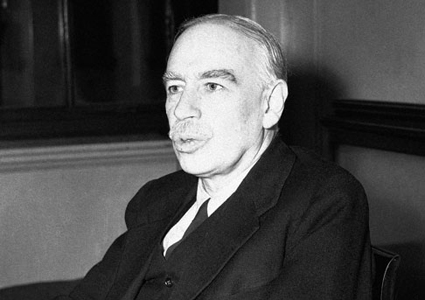
 Father of a mistaken orthodoxy: John Maynard Keynes
Since President Obama's re-election the American financial press and world stock markets have been anxious about the so-called "fiscal cliff". This is the sharp fall in the US budget deficit that would occur in 2013 on present policies, which include the cancellation of tax cuts dating back to George W. Bush's presidency. The Congressional Budget Office has estimated that next year these policies would lead to a fall in the deficit of over $500 billion, roughly half of the existing budget gap. Keynesian textbook orthodoxy says that the projected deficit reduction represents a severe tightening of fiscal policy, which will withdraw spending power from the economy and so reduce demand, output and employment.
But will it? The thinking behind modern fiscal policy was first developed in Keynes's 1936 General Theory, particularly in its Chapter 10, and with far more clarity in his 1939 essay, "How to Pay for the War". The essence of Keynes's message was that taxation and government spending should be varied to influence the total level of expenditure. By according government a benign role in managing the economy, Keynes's ideas were plausible and attractive to "the socialists of all parties", to quote one of Hayek's better-known phrases. For many economists in the world's top finance ministries, Keynesian textbook orthodoxy is the textbook orthodoxy today. In their view, if a downturn in the economy threatens, the budget deficit must be increased. Further, to advocate strong action to cut the budget deficit in a recession is economic illiteracy, even madness.
However, the textbook maxims of Keynesian fiscalism do have their critics. Towards the end of his life these included Milton Friedman, the redoubtable champion of monetarism and the free market. In January 1996 two British economists, Brian Snowdon and Howard Vane, interviewed Friedman in his San Francisco apartment. They asked him: "In the light of your work on the consumption function and monetary economics in general, what role do you see for fiscal policy in a macroeconomic context?" His rebuff to the Keynesian consensus was trenchant:
None. I believe that fiscal policy will contribute most if it doesn't try to offset short-term movements in the economy. I'm expressing a minority view here, but it's my belief that fiscal policy is not an effective instrument for controlling short-term movements in the economy.


Post your comment
- ONLINE ONLY: Will Shale Gas Save the British Economy?
- ONLINE ONLY: A Healthcare System Suffocated by Bureaucrats
- Welcome to Obama's Parallel Universe
- Why the West Can't Do Business With Iran
- Writing and Rewriting the Bible in the Time of Jesus
- We Can Have a Free Press and Justice Too
- Calling All Christians: Prepare For Exile
- History Lessons for the 21st-Century Classroom
- ONLINE ONLY: Lang's Misunderstood Life
- ONLINE ONLY: Translating the Autumn Statement
- ONLINE ONLY: Radical Chic and the Corruption of Art
- How Supercam Can Win the Next Election
- The Indelible Terror of the Cruelty of Children
- How to Exorcise the Ghost of Penury Yet To Come
- A Pilgrimage Through Paddy's London
- The Long Life of a Charming Nomad
- ONLINE ONLY: Defending Israel in a Changed World
- Eric Hobsbawm: Companion of Dishonour
- Class Struggle in the Classroom
- Confessions of a Bourgeois Comrade
