



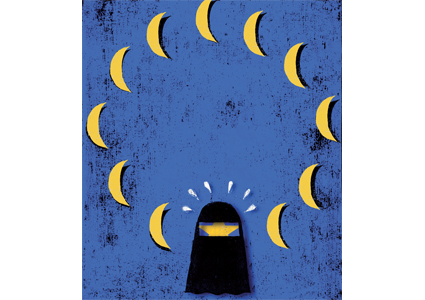
Justin Vaisse is not yet a household name but this young man may go far. Of North African background, he has taught at Sciences Po in Paris and been a speechwriter for the French Minister of Defence. Currently at Washington's Brookings Institution, he is the leading French expert on — and the nemesis of — the neoconservatives. The fact that he is spending time in America may not necessarily affect his political prospects. After all, Georges Clemenceau did the same. Of late, he has discovered and given publicity to what he calls a new genre in American literature: Eurabia. Among the chief protagonists in this new genre he mentions above all Bernard Lewis, the greatest Orientalist of our time, and Bat Ye'or, who popularised the term "Eurabia" to warn against the Islamicisation of Europe. In view of the homeric struggle between the two sides — Lewis has been accused of appeasement, if not worse, by the other side — it seems somewhat far-fetched to find a common denominator for them, but Vaisse is a resourceful man.
Among the European protagonists of the Eurabian thesis, Vaisse mentions Ayaan Hirsi Ali, who was born in Somalia and now lives in the US. I am also named, although it helps him very little that in Last Days of Europe (Thomas Dunne, 2007) I devoted several pages to my unhappiness with the very term "Eurabia" which, for a variety of reasons, I have never used and thought misleading. The great majority of Muslims in Britain are not Arab but Pakistani or Bangladeshi in origin. In Germany, the Turks greatly outnumber all other Muslims. In France, the majority is North and West African. In Belgium, Turkish and Moroccan, and so on. These are not minor, pedantic issues because traditions, culture, language and even the forms of Islam practised differ considerably in Europe. While the Arabs have tried to attain positions of leadership in the European Muslim communities, this has merely given additional impetus to tensions (and among the Arabs there is a bitter struggle between Shias and Sunnis). Arabs traditionally believe that only they are the true sons of the Prophet, giving them a feeling of superiority over other Muslims.
Vaisse has not been alone in his campaign against the prophets of Eurabia. He found several sober, level-headed and well informed experts such as Jocelyne Cesari at Harvard or Jytte Klausen, a Danish scholar at Brandeis. Dr Cesari argues that there has been in the Muslim communities a strong trend towards conservativism, but that this is not tantamount to support for terrorism. This is true and some in the West have paid insufficient attention to it. But even here a word of caution is necessary. Most of our knowledge on the mood and the political orientation of Muslim communities all over the world rests on public opinion polls, most prominently those carried out by the Pew Global Attitudes Project. How reliable, though, are these polls? To give an example: a figure of 13 per cent is usually given for those in Britain sympathising with al-Qaeda. But can it be taken for granted that those asked will reveal to strangers (who, for all they know, may be agents of the security forces) the secrets of their hearts and minds? The answer seems obvious.
To return to Vaisse's fellow experts: Professor Klausen is a happy soul. The author of Islamic Challenge (OUP, 2005), she reached the conclusion that there was no such challenge. She had interviewed some 300 professional Muslim men and women in various European countries, all middle- or upper-class businessmen, professors, lawyers and physicians, all of them reasonably content with their life and circumstances, identifying with their new countries and eager to collaborate in their social, political and economic life. There are indeed such people: the emerging Muslim elite. But the fact that these contented people are only so far a happy few seems not to have occurred to Professor Klausen. What influence do they have in their respective communities? Do the young people listen to them or to the imams? To what extent do they still identify with their erstwhile community? In Europe, most of them have moved out of Muslim ghettoes. This is not the case in India, where the Muslim middle- and upper-classes prefer to live with their coreligionists.


- We Need Churchill's Vison of Liberty More Than Ever
- The Play's The Thing, So Leave The Words Alone
- An Aesthetic and Moral Disaster
- How we Syrians destroyed our home — with your help
- Euphoric Labour won’t win power led by a pied piper
- Don’t be ‘difficult’ — try ‘formidable’, Mrs May
- Enough is enough of terror — but also of our self-doubt
- Iraq’s Christians pray for help that never comes
- The Atlantic alliance may be broken beyond repair
- Catholic tastes: both English and European
- Brexit as myth: Exodus, Reckoning, or Sacrifice?
- A Decent Woman Betrayed By Her Gruesome Twosome
- Can Macron Save France — Or Is He Its Undertaker?
- Europe's Revival Is At Hand, Thanks To Brexit
- Is This The Most Important British General Election Since 1979?
- The New Europe Must Be About More Than Money
- Our Best Brexit Policy Is All-Out Free Trade
- The Bursting Of Our 'Kabubble' Fantasies
- Gambling On A Greater More Gracious Britain
- Xi Versus Trump: The Emperor And The Tycoon

- Cultural Climate Change
- Opposites meet in the land of Scrugletopia
- The Battle Against The Philistines Never Ceases
- Home from home for the Bolshevik elite
- Can Macron Save France — Or Is He Its Undertaker?
- How The EU Elite Paved The Way For Populism
- Why France Is Revolting Against The Ancien Regime
- A Decent Woman Betrayed By Her Gruesome Twosome
10:07 PM
5:07 PM
10:07 AM