


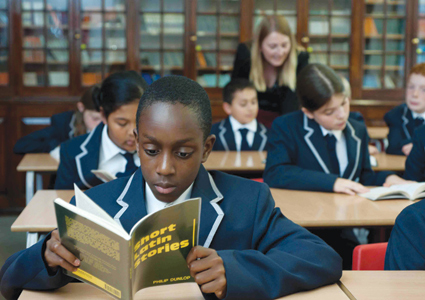
A return to traditional methods: Desks are arranged in rows during Latin lessons at Toby Young's West London Free School
Jane Mitchell was the daughter of a lorry driver. Reflecting on her education during the 1940s, she wrote: "I enjoyed the mental drill and exercise I was put through, even the memorising from our geography book of the principal rivers and promontories of the British Isles . . . It never occurred to me to question the purposes or methods of what we were made to do at school. The stuff was there to be learned, and I enjoyed mopping it up."
Jane went on to become a classics lecturer at Reading University. It is hard to imagine a child of her background taking so academic a career route today. Then again, it is hard to imagine that such a child today would receive the rigorous education she enjoyed.
What has changed between then and now? This question has dominated my thoughts since I became a history teacher at one of Britain's abundant failing state schools. Having been educated in the private sector since the age of seven, I was not ready for the deprivation that confronted me at my new job. However, this was no material deprivation. At around £6,200 a year, average state spending per pupil is not far off the cost of a good private day school. Instead, it was a deprivation of effective teaching methods.
One in five pupils leaves British secondary schools functionally illiterate. It comes as no surprise, therefore, that a 2010 Confederation of British Industry report found 22 per cent of employers who hired school-leavers were obliged to give them remedial training in literacy. How can such a large proportion of our pupils pass through 11 years of state schooling and still not have the basics of literacy? The answer can be found in a pedagogical outlook which renounces rigour, embeds underachievement, and dominates the state sector.
During my teacher training, the university reading list covered the canon of "child-centred" educators. One of the most influential is the Californian academic and self-styled "liberation psychologist" Carl Rogers. In his 1969 work Freedom to Learn he proclaimed, "Traditional teaching is an almost completely futile, wasteful, over-rated function in today's changing world," adding, "no one should ever be trying to learn something for which one sees no relevance."


- Admit It, Mr Kerry: You Blundered
- Bismarck Versus Blair — A Foreign Policy Crossroads
- Arab Spring, Islamist Summer — What Next?
- The Diplomat the Whole World Ignores
- The Blob Has Run Schools For Decades. Not Any More
- Would You Intervene — Or Pass On The Other Side?
- He Died That Others Might Live In Peace
- The Hero's Journey is Hollywood's McMyth
- Online Only: Countering the Counter-Jihadists
- Online Only: The Price Paid for Criticising Islam
- 'Please Sir, I Just Want to Learn More'
- Why Students Should Be Glad To Pay Tuition Fees
- A 'Liberal Racist'? Me? I Felt Like a Heretic
- Demolish the Relics of Yesterday's Future
- Was Britain Right To Go To War In 1914?
- German Victorians Who Helped Transform Britain
- The Alternative History of an Undivided India
- Online Only: Heirs to the Left
- ONLINE ONLY: The Hayward Gallery's Fashionable Primitives
- ONLINE ONLY: A Spiritual Corner of Southwark

- The Zombie Argument that Refuses to Die
- Online Only: The Price Paid for Criticising Islam
- Overrated: Dan Brown
- Overrated: George Monbiot
- Is the Brain the Key to Understanding Religion?
- 'Please Sir, I Just Want to Learn More'
- An Assault on Free Speech at the LSE
- The Alternative History of an Undivided India
- The Zombie Argument that Refuses to Die
- Online Only: The Price Paid for Criticising Islam
- Overrated: Dan Brown
- Overrated: George Monbiot
- Is the Brain the Key to Understanding Religion?
- 'Please Sir, I Just Want to Learn More'
- An Assault on Free Speech at the LSE
- The Alternative History of an Undivided India
- Decline and Fall of the History Men
- Uncritical Theorists Who Misread the Nazis
- The Zombie Argument that Refuses to Die
- The Banality of Hannah Arendt
- From Kitsch to Cool: Picasso and Modern Art
- Is the Brain the Key to Understanding Religion?
- Time to Wise Up to the Muslim Brotherhood
- Midfield Virtuoso Finds His Perfect Pitch
4:05 PM