


In his novel Les Ambassades Roger Peyrefitte describes how, as his wealthy young hero's train crosses France in 1937, the blinds of the restaurant car are drawn so as not to arouse the anger of the supporters of Léon Blum's Popular Front government. I thought of this vignette as I made my way to Paris on the afternoon of France's presidential election. A promised top income tax rate of 75 per cent would soon be adding to London's already substantial French population.
Later that afternoon, as I walked through the streets of the prosperous 7th arrondissement and past the gilded dome above Napoleon's tomb, there was no evident sense of either anticipation or anxiety. French law stipulates that there can be no campaigning on election day and, were it not for an occasional queue outside a polling station, one would hardly have known that an election was taking place.
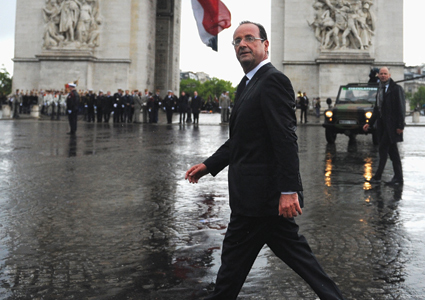
Raining on his parade: What kind of socialist will Angela Merkel allow Hollande to be? (Getty)
All of this changed at exactly 8pm. At this precise moment, as polling closed and families and friends assembled around their television sets, the result was made known to the French nation. As predicted, Hollande had won and there on our screens were scenes of joy outside the Socialist Party headquarters in the Rue de Solferino. No one had as yet actually counted the votes but this was what the exit polls told us. Indeed, such is the faith of the French in opinion polls that one wonders why the electorate cannot be saved the effort of actually turning out to vote.
It was at this point that I remembered that there is nothing quite as awful as French television. Nor, I realised for the first time, was there anything quite as glacial as the fixed smile on the face of Ségolène Royal, Hollande's former partner, the mother of his four children and failed presidential candidate in 2007.
Things started to get more interesting when Nicolas Sarkozy took to the stage at Paris's Salle de la Mutualité. For a man who hoped against hope and who believed, until the last, that victory was within his grasp, he bore his defeat with great dignity. He congratulated his opponent, thanked his supporters, took personal responsibility for the defeat, spoke of eternal France, and was gone. Perhaps never to return.


Post your comment
- Admit It, Mr Kerry: You Blundered
- Bismarck Versus Blair — A Foreign Policy Crossroads
- Arab Spring, Islamist Summer — What Next?
- The Diplomat the Whole World Ignores
- The Blob Has Run Schools For Decades. Not Any More
- Would You Intervene — Or Pass On The Other Side?
- He Died That Others Might Live In Peace
- The Hero's Journey is Hollywood's McMyth
- Online Only: Countering the Counter-Jihadists
- Online Only: The Price Paid for Criticising Islam
- 'Please Sir, I Just Want to Learn More'
- Why Students Should Be Glad To Pay Tuition Fees
- A 'Liberal Racist'? Me? I Felt Like a Heretic
- Demolish the Relics of Yesterday's Future
- Was Britain Right To Go To War In 1914?
- German Victorians Who Helped Transform Britain
- The Alternative History of an Undivided India
- Online Only: Heirs to the Left
- ONLINE ONLY: The Hayward Gallery's Fashionable Primitives
- ONLINE ONLY: A Spiritual Corner of Southwark

- The Zombie Argument that Refuses to Die
- Online Only: The Price Paid for Criticising Islam
- Overrated: Dan Brown
- Overrated: George Monbiot
- Is the Brain the Key to Understanding Religion?
- 'Please Sir, I Just Want to Learn More'
- An Assault on Free Speech at the LSE
- The Alternative History of an Undivided India
- The Zombie Argument that Refuses to Die
- Online Only: The Price Paid for Criticising Islam
- Overrated: Dan Brown
- Overrated: George Monbiot
- Is the Brain the Key to Understanding Religion?
- 'Please Sir, I Just Want to Learn More'
- An Assault on Free Speech at the LSE
- The Alternative History of an Undivided India
- Decline and Fall of the History Men
- Uncritical Theorists Who Misread the Nazis
- The Zombie Argument that Refuses to Die
- The Banality of Hannah Arendt
- From Kitsch to Cool: Picasso and Modern Art
- Is the Brain the Key to Understanding Religion?
- Time to Wise Up to the Muslim Brotherhood
- Midfield Virtuoso Finds His Perfect Pitch
- Online Only: The Price Paid for Criticising Islam
- Overrated: George Monbiot
- Letter from Ukraine: Reviving Lost Literature
- On Pilgrimage with the Hasids
- The Blob Has Run Schools For Decades. Not Any More
- Tsar Of The Holy Land
- Bismarck Versus Blair — A Foreign Policy Crossroads
- My Dieting Guide: Listen To Mother