


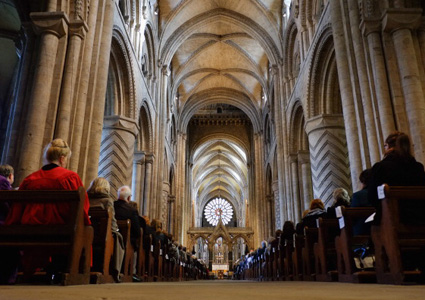
The churchgoing minority: David Cameron called Britain a Christian country but only 14 per cent describe themselves as 'practising' (credit: Getty)
It is a fact, remarked upon by admirers and critics alike, that David Cameron, even after so much media exposure, remains hard to pin down. People think he looks the part as prime minister. But they cannot relate to him. He tries to seem authentic. But the more he reveals himself, the less tangible he is. Whenever he devises a phrase to explain the essence of his policies — the Big Society being the obvious example — he sows confusion and inspires ridicule. Cameron's recent profession of his religious faith (sort of) in an article, over Easter, in the Church Times, has not quite suffered that fate. But the more people reflect upon it, the larger the question marks are bound to become.
David Cameron is a political animal to the tips of his claws. There is nothing he does that is not political, whether speaking about his family (which he does with less reserve than any previous prime minister), or displaying his taste in popular music, or — as in this case — reflecting on his religion. All is for immediate political effect.
Mrs Thatcher was the last serious practitioner of the political sermon. Her speeches in St Lawrence Jewry in 1978 and 1981 do not, though, nowadays read well, dipping and dodging, as they do, between biblical principles and practical policies, while modestly (and unconvincingly) denying direct connection between the two. Her last such address, to the General Assembly of the Church of Scotland in 1988, created such a row that she went off the subject altogether. Henceforth, she indignantly declaimed against any intrusions of "preachy" material in her speeches. But she did, more or less, get away with these excursions, because people knew of her strict Methodist background, respected her sincerity, and imagined her more religious than she was.
David Cameron is on trickier territory. In his Church Times article he claimed that he knew "how powerful faith can be in the toughest of times". Yet the reader was left unsure of why. The reference was perhaps to family trauma. But this hardly provides an answer. People have always assumed that Cameron does not really believe very much at all, about God or, indeed, anything. Yet here he was asserting that his faith had kept him going. But what faith?
The answer seems not to be Christianity, but rather the Church of England. Indeed, Cameron's article offers what can only be considered — even by an outsider — a caricature of Anglicanism, which he seems to divorce from any theological principles whatsoever. He stated: "I am a member of the Church of England, and I suspect, a rather classic one: not that regular in attendance, and a bit vague on some of the more difficult parts of the faith." (Emphasis added). Just to ensure that the point was not lost, he added: "I am not one for doctrinal purity." It is, to say the least, unusual to prefer impure to pure doctrine. The deliberate espousing of theological falsehood is a rum position even for temperamental latitudinarians. It is hard to imagine that even the most indulgent liberal Anglican bishop would altogether agree with it, or that any sincere Anglican would do other than to regret it.
So what does the Prime Minister like about the Anglican Church? It is the externals. He explicitly mentions the "national role" of the Church, its "liturgy", and "the architecture and cultural heritage". Many will agree with him. Indeed, as is often the case, Cameron manages to reflect with uncanny accuracy the defining superficialities of the age. It is the source of his political power and his easy charm. But he then made an extraordinarily ambitious assertion, one which gladdened the hearts of the Tory press, and which led to an almost endless stream of comment for and against, namely that "we should be more confident about our status as a Christian country". (Again, emphasis added).
Like this article? Share, save or print using the icons below:


More Features
- The US Can Still Help Save Syria — and Iraq
- Russian Resurgence has Blindsided Nato
- On Europe, Nothing Less than Treaty Change will do
- Putin has his Useful Idiots on the Left and the Right
- Sarajevo: Where the Century of Terror Began
- Allen Lane’s Pelicans Take Wing Once More
- How Not to Remember the First World War
- Opera is Not Just Our Most Expensive Noise
- Jonathan Miller: One Man, Two Cultures
- Without a Big Idea, Cameron Will Lose
- How to Get School Competition Right
- The War on the Firmest Bulwark of our Liberty
- How Modern Liberals Created Nigel Farage
- Caught in the Trap of His Own Metaphysics
- In Search of My Father, Agent of the Comintern
- Geoffrey Hill and the poetry of ideas
- Master of the Glories of the English Country Garden
- Independence Will Do Nothing for Scots
- Bullying and Bluff on the Road to Referendum
- Maidan is a Reminder of our Forgotten Values
Popular Standpoint topics

9:05 AM