


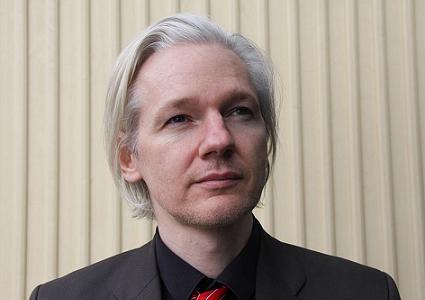
Serious matters are in dispute in the debate about Julian Assange. Supporters of the WikiLeaks founder talk about human rights, freedom of speech and democracy. His opponents talk about espionage, the end of honest diplomacy and the safety of soldiers on the frontlines. It is a noisy debate. Yet most people agree that serious matters are at stake in it, and that Assange is a serious man. His intellectual hero, we learn from David Leigh and Luke Harding's new book, is Aleksandr Solzhenitsyn.
Leigh is the investigations editor at the Guardian and Harding is the newspaper's Moscow correspondent. They have written an engaging and thorough account of the Australian ex-hacker and his band of "cyber radicals". They look closely at the difficult partnership between WikiLeaks and the mainstream media, a unique alliance which led to the publication of the first US diplomatic cables. In recounting the Guardian's relationship with Assange, Leigh and Harding draw out the contradictions in his character and write critically about both sides of the debate over his work.
The cables were "the biggest leak in history". They lent shape and context to important events, and gave us insight into diplomatic manoeuvring and political wrangling. Many of them were fascinating to read. WikiLeaks, furthermore, is a fascinating organisation, and one which might herald lasting changes for the media. But it was the tireless legwork of reporters that turned the immense mass of data into solid news stories. That data was allegedly leaked by US soldier Bradley Manning.
Manning is the hero of the book. He was naive, confused and unstable. Yet he participated in the Iraq war and thought deeply about what he saw. Then he made some conclusions about US actions in Iraq. Whether those conclusions were right or wrong is part of a wider debate. Either way, he made a decision to act based on his principles. Assange, meanwhile, took the data and became "the world's most famous man".
But isn't Assange supposed to be the hero? Leigh and Harding write that Assange enjoys a "vast worldwide fan-base", though it does not extend to the US. They add that despite "the hostility of government officials, and the ‘latex gloves' (as Vanity Fair put it) with which the mainstream media have handled him, much of the world has nothing but admiration for WikiLeaks and Julian Assange". In other words, Assange is considered an authority on serious matters by many people, to whom his ideas are important.


- Admit It, Mr Kerry: You Blundered
- Bismarck Versus Blair — A Foreign Policy Crossroads
- Arab Spring, Islamist Summer — What Next?
- The Diplomat the Whole World Ignores
- The Blob Has Run Schools For Decades. Not Any More
- Would You Intervene — Or Pass On The Other Side?
- He Died That Others Might Live In Peace
- The Hero's Journey is Hollywood's McMyth
- Online Only: Countering the Counter-Jihadists
- Online Only: The Price Paid for Criticising Islam
- 'Please Sir, I Just Want to Learn More'
- Why Students Should Be Glad To Pay Tuition Fees
- A 'Liberal Racist'? Me? I Felt Like a Heretic
- Demolish the Relics of Yesterday's Future
- Was Britain Right To Go To War In 1914?
- German Victorians Who Helped Transform Britain
- The Alternative History of an Undivided India
- Online Only: Heirs to the Left
- ONLINE ONLY: The Hayward Gallery's Fashionable Primitives
- ONLINE ONLY: A Spiritual Corner of Southwark

- The Zombie Argument that Refuses to Die
- Online Only: The Price Paid for Criticising Islam
- Overrated: Dan Brown
- Is the Brain the Key to Understanding Religion?
- Overrated: George Monbiot
- Time to Wise Up to the Muslim Brotherhood
- 'Please Sir, I Just Want to Learn More'
- The Alternative History of an Undivided India
- The Zombie Argument that Refuses to Die
- Online Only: The Price Paid for Criticising Islam
- Overrated: Dan Brown
- Is the Brain the Key to Understanding Religion?
- Overrated: George Monbiot
- Time to Wise Up to the Muslim Brotherhood
- 'Please Sir, I Just Want to Learn More'
- The Alternative History of an Undivided India
- Decline and Fall of the History Men
- Uncritical Theorists Who Misread the Nazis
- The Zombie Argument that Refuses to Die
- The Banality of Hannah Arendt
- From Kitsch to Cool: Picasso and Modern Art
- Is the Brain the Key to Understanding Religion?
- Time to Wise Up to the Muslim Brotherhood
- Midfield Virtuoso Finds His Perfect Pitch
7:03 PM
12:03 PM
5:03 AM