


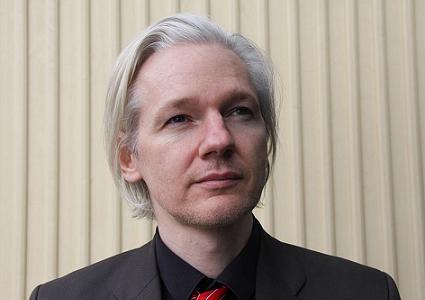
Serious matters are in dispute in the debate about Julian Assange. Supporters of the WikiLeaks founder talk about human rights, freedom of speech and democracy. His opponents talk about espionage, the end of honest diplomacy and the safety of soldiers on the frontlines. It is a noisy debate. Yet most people agree that serious matters are at stake in it, and that Assange is a serious man. His intellectual hero, we learn from David Leigh and Luke Harding's new book, is Aleksandr Solzhenitsyn.
Leigh is the investigations editor at the Guardian and Harding is the newspaper's Moscow correspondent. They have written an engaging and thorough account of the Australian ex-hacker and his band of "cyber radicals". They look closely at the difficult partnership between WikiLeaks and the mainstream media, a unique alliance which led to the publication of the first US diplomatic cables. In recounting the Guardian's relationship with Assange, Leigh and Harding draw out the contradictions in his character and write critically about both sides of the debate over his work.
The cables were "the biggest leak in history". They lent shape and context to important events, and gave us insight into diplomatic manoeuvring and political wrangling. Many of them were fascinating to read. WikiLeaks, furthermore, is a fascinating organisation, and one which might herald lasting changes for the media. But it was the tireless legwork of reporters that turned the immense mass of data into solid news stories. That data was allegedly leaked by US soldier Bradley Manning.
Manning is the hero of the book. He was naive, confused and unstable. Yet he participated in the Iraq war and thought deeply about what he saw. Then he made some conclusions about US actions in Iraq. Whether those conclusions were right or wrong is part of a wider debate. Either way, he made a decision to act based on his principles. Assange, meanwhile, took the data and became "the world's most famous man".
But isn't Assange supposed to be the hero? Leigh and Harding write that Assange enjoys a "vast worldwide fan-base", though it does not extend to the US. They add that despite "the hostility of government officials, and the ‘latex gloves' (as Vanity Fair put it) with which the mainstream media have handled him, much of the world has nothing but admiration for WikiLeaks and Julian Assange". In other words, Assange is considered an authority on serious matters by many people, to whom his ideas are important.


- We Need Churchill's Vison of Liberty More Than Ever
- The Play's The Thing, So Leave The Words Alone
- An Aesthetic and Moral Disaster
- How we Syrians destroyed our home — with your help
- Euphoric Labour won’t win power led by a pied piper
- Don’t be ‘difficult’ — try ‘formidable’, Mrs May
- Enough is enough of terror — but also of our self-doubt
- Iraq’s Christians pray for help that never comes
- The Atlantic alliance may be broken beyond repair
- Catholic tastes: both English and European
- Brexit as myth: Exodus, Reckoning, or Sacrifice?
- A Decent Woman Betrayed By Her Gruesome Twosome
- Can Macron Save France — Or Is He Its Undertaker?
- Europe's Revival Is At Hand, Thanks To Brexit
- Is This The Most Important British General Election Since 1979?
- The New Europe Must Be About More Than Money
- Our Best Brexit Policy Is All-Out Free Trade
- The Bursting Of Our 'Kabubble' Fantasies
- Gambling On A Greater More Gracious Britain
- Xi Versus Trump: The Emperor And The Tycoon

- Cultural Climate Change
- Opposites meet in the land of Scrugletopia
- The Battle Against The Philistines Never Ceases
- Home from home for the Bolshevik elite
- Can Macron Save France — Or Is He Its Undertaker?
- How The EU Elite Paved The Way For Populism
- Why France Is Revolting Against The Ancien Regime
- A Decent Woman Betrayed By Her Gruesome Twosome
7:03 PM
12:03 PM
5:03 AM