


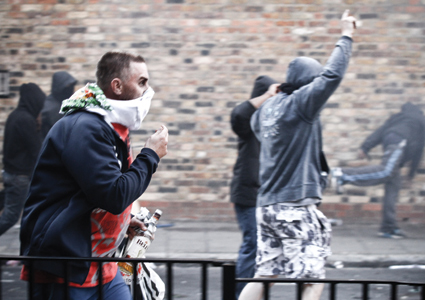
The Big Loot: The rioters of August 2011 dramatised the collapse of moral understanding in Britain (Getty Images)
The first major shock for the British in our new century is that we have become seriously corrupt. The scandal of parliamentary expenses had hardly died down before we were plunged into the whimsies of an educational system in which examinations rather lost their challenge for students who had been coached in the right answers beforehand. And these shocks were dramatised in the Big Loot of August when rioters and arsonists had the run of large areas of British cities. As if all this were not enough, the very model of moral conduct in sport, namely cricket, has been tarnished, not merely internationally, but even down to county level.
It is these events that have partly given rise to the mistake of believing that capitalism is failing. There might possibly be a case for increased, or perhaps just smarter, regulation of commerce, but there is certainly no alternative to the basic freedoms of our economic life. The rise of corruption among us is essentially a moral collapse and, if anything can be done about it, the solution can only be found in the moral and social sphere. But first we must be clear about what corruption actually is.
In the first instance, of course, the word is a metaphor referring to disease or putrefaction, which should bring a vivid perceptual revulsion against human conduct that might otherwise seem to be no different from lots else going on. Corruption involves both the doing of bad things and the not doing of good ones. The commonest form is when some official will only perform his duty — issuing a passport or a licence, for example — on payment of a bribe. This reportedly often happens in Africa. It has been estimated that the average Kenyan family spends about a third of its income on bribes. In such countries, corruption is systemic rather than — as we hope in Britain — episodic. Every barrel has a few bad apples, but a whole barrel of them is a different thing altogether.
Diagnosing corruption requires the idea of duty, because our common codification of the moral life in terms of rights sometimes facilitates claims to corrupt payments. It can make things worse.
In international league tables ranking corruption, Britain usually scores quite well, along with other Anglophone states, northern Europe and one or two Asian paradigms such as Singapore and Hong Kong. The rest of the world, we may conclude, is fairly systematically corrupt. The causes of this are complex, but two are evident. Most states in the world, for all their modish allegiance to institutional democracy in the form of elections and parliaments, have a tradition of despotic rule. In this tradition, success depends on accommodation with power, and bribes or favours are a great help. Secondly, modern individualism is only slowly replacing a society of status structures — in terms of caste, seniority or sex — which can seldom avoid allowing the higher status considerable scope to tyrannise over the lower.


- Admit It, Mr Kerry: You Blundered
- Bismarck Versus Blair — A Foreign Policy Crossroads
- Arab Spring, Islamist Summer — What Next?
- The Diplomat the Whole World Ignores
- The Blob Has Run Schools For Decades. Not Any More
- Would You Intervene — Or Pass On The Other Side?
- He Died That Others Might Live In Peace
- The Hero's Journey is Hollywood's McMyth
- Online Only: Countering the Counter-Jihadists
- Online Only: The Price Paid for Criticising Islam
- 'Please Sir, I Just Want to Learn More'
- Why Students Should Be Glad To Pay Tuition Fees
- A 'Liberal Racist'? Me? I Felt Like a Heretic
- Demolish the Relics of Yesterday's Future
- Was Britain Right To Go To War In 1914?
- German Victorians Who Helped Transform Britain
- The Alternative History of an Undivided India
- Online Only: Heirs to the Left
- ONLINE ONLY: The Hayward Gallery's Fashionable Primitives
- ONLINE ONLY: A Spiritual Corner of Southwark

- The Zombie Argument that Refuses to Die
- Online Only: The Price Paid for Criticising Islam
- Overrated: Dan Brown
- Overrated: George Monbiot
- Is the Brain the Key to Understanding Religion?
- 'Please Sir, I Just Want to Learn More'
- An Assault on Free Speech at the LSE
- The Alternative History of an Undivided India
- The Zombie Argument that Refuses to Die
- Online Only: The Price Paid for Criticising Islam
- Overrated: Dan Brown
- Overrated: George Monbiot
- Is the Brain the Key to Understanding Religion?
- 'Please Sir, I Just Want to Learn More'
- An Assault on Free Speech at the LSE
- The Alternative History of an Undivided India
- Decline and Fall of the History Men
- Uncritical Theorists Who Misread the Nazis
- The Zombie Argument that Refuses to Die
- The Banality of Hannah Arendt
- From Kitsch to Cool: Picasso and Modern Art
- Is the Brain the Key to Understanding Religion?
- Time to Wise Up to the Muslim Brotherhood
- Midfield Virtuoso Finds His Perfect Pitch
- Online Only: The Price Paid for Criticising Islam
- Overrated: George Monbiot
- Letter from Ukraine: Reviving Lost Literature
- On Pilgrimage with the Hasids
- The Blob Has Run Schools For Decades. Not Any More
- Tsar Of The Holy Land
- Bismarck Versus Blair — A Foreign Policy Crossroads
- My Dieting Guide: Listen To Mother
3:02 PM