



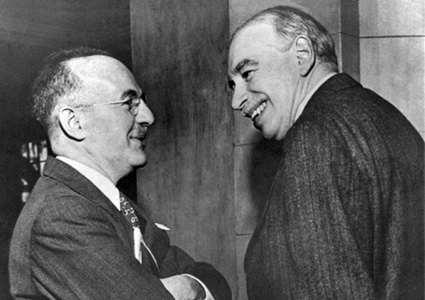
John Maynard Keynes (right): Have his disciples been right about him?
A key achievement of Keynes's General Theory was to guide economists towards better organisation of their analysis of the economy as a whole ("the macro-economy"). Crucially, national income was set when aggregate demand was equal to aggregate supply. A number of conditions had to be met for this to hold, including equality of investment with saving, and equality of the demand to hold money balances with the quantity of money created by the banking system.
I am sorry if my opening paragraph in reply to Wolf's comment is dry as dust; it ought to be familiar to readers who have had the misfortune to have endured a university macroeconomics course. But basic ideas have to be recalled if we are to make progress. The core debating issue between us is, "Does an increase in the budget deficit increase aggregate demand?". In my two Standpoint articles on the subject ("Don't let the Keynesians wreck the recovery", December 2014, and "Keynesians fear the US fiscal cliff. I don't", January/February 2013) I focused on this question. I demonstrated that, over the last 30 years in the US, the answer is "No, for the great majority of the time." An analysis of the UK data yields much the same conclusion.
Keynesians like Martin Wolf (as well as Paul Krugman, Larry Summers, Robert Skidelsky and many others) believe that a systematic and reliable link holds between an increase in the budget deficit and expansion of demand. Their theory is contradicted by the evidence and is wrong. They criticised George Osborne in 2011 when he committed the UK to a medium-term programme of budgetary restraint. Because their theory is wrong, these criticisms have proved misguided. Contrary to their warnings, a recovery has occurred in association with a significant reduction in the budget deficit. Moreover, the UK pattern under Osborne has been seen many times, both in other countries and in the UK's own past.
Plainly, my concern was about the effect of policy on aggregate demand. Wolf does not address the evidence or my argument. Much of his comment is instead about the disappointing performance of aggregate supply since the Great Recession. Output growth has indeed been weak compared to that in other recoveries in the last 70 years, largely—as Wolf observes—because of "the remarkable stagnation of labour productivity". But this has no bearing on the matter we are debating, namely the ability of fiscal policy to influence aggregate demand.
I am sorry if my opening paragraph in reply to Wolf's comment is dry as dust; it ought to be familiar to readers who have had the misfortune to have endured a university macroeconomics course. But basic ideas have to be recalled if we are to make progress. The core debating issue between us is, "Does an increase in the budget deficit increase aggregate demand?". In my two Standpoint articles on the subject ("Don't let the Keynesians wreck the recovery", December 2014, and "Keynesians fear the US fiscal cliff. I don't", January/February 2013) I focused on this question. I demonstrated that, over the last 30 years in the US, the answer is "No, for the great majority of the time." An analysis of the UK data yields much the same conclusion.
Keynesians like Martin Wolf (as well as Paul Krugman, Larry Summers, Robert Skidelsky and many others) believe that a systematic and reliable link holds between an increase in the budget deficit and expansion of demand. Their theory is contradicted by the evidence and is wrong. They criticised George Osborne in 2011 when he committed the UK to a medium-term programme of budgetary restraint. Because their theory is wrong, these criticisms have proved misguided. Contrary to their warnings, a recovery has occurred in association with a significant reduction in the budget deficit. Moreover, the UK pattern under Osborne has been seen many times, both in other countries and in the UK's own past.
Plainly, my concern was about the effect of policy on aggregate demand. Wolf does not address the evidence or my argument. Much of his comment is instead about the disappointing performance of aggregate supply since the Great Recession. Output growth has indeed been weak compared to that in other recoveries in the last 70 years, largely—as Wolf observes—because of "the remarkable stagnation of labour productivity". But this has no bearing on the matter we are debating, namely the ability of fiscal policy to influence aggregate demand.
Like this article? Share, save or print using the icons below:


Post your comment
More Features
- Mr Cameron, Show The Country That You Care
- Campaign Diary
- Defying Duopoly: The Rise Of The Insurgents
- Don't Rig The System In Favour Of Coalitions
- Warring Gangsters Who Run The Country
- Political Correctness Is Devouring Itself
- An Archival Treasure Trove—And All Online
- Do we value freedom of speech in Britain?
- Can Europe's Jews Feel Safe Alongside Muslims?
- We Cannot Avoid The Battle Over Blasphemy
- Inside The World Of 'Non-Violent' Islamism
- We Can Fix The Economy But Not Human Nature
- The Keynesian Versus The Monetarist: A Lost Decade
- The New Language Of Political Narcissism
- Two Words You Won't Hear This Election: Foreign Policy
- The Many Faces Of Holocaust Denial
- Why Is 'Fifty Shades of Grey' the New Normal?
- Obama scuttles. America retreats. Things fall apart
- Putin and the Art of Political Fantasy
- An English parliament: the only way to save the UK
Popular Standpoint topics

- The Loss Of Faith Made Music Mute
- The Great Betrayal: How Liberals Appease Islam
- Overrated: Russell Brand
- Political Correctness Is Devouring Itself
- The New Language Of Political Narcissism
- Why The World Still Loves Shakespeare
- Don’t Listen to Britain’s Designer Demagogues
- An English parliament: the only way to save the UK
- The Loss Of Faith Made Music Mute
- The Great Betrayal: How Liberals Appease Islam
- Overrated: Russell Brand
- Political Correctness Is Devouring Itself
- The New Language Of Political Narcissism
- Why The World Still Loves Shakespeare
- Don’t Listen to Britain’s Designer Demagogues
- An English parliament: the only way to save the UK