


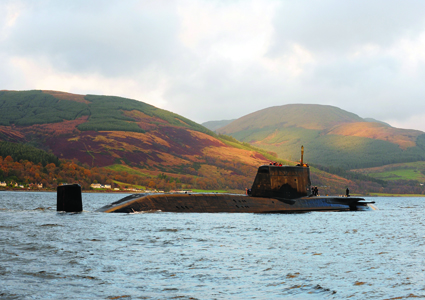
Nuclear nostalgia: Among many Scots, the Trident submarines are an unpopular symbol of Britain's imperial pretensions
Scotland may vote for independence on September 18. At the time of writing, this still seems unlikely, but the No, or Better Together, campaign has suffered a wobble. An unidentified senior minister reportedly said that an independent Scotland might be able to enjoy a currency union with the rest of the UK, something which a united front of George Osborne, Ed Balls and Danny Alexander had ruled out. In saying so, the minister implicitly supported the Scottish National Party's assertion that the unionist parties were engaging in bluff, bluster and bullying. According to one opinion poll, 45 per cent of Scots agree with this. That is a higher percentage than currently intend to vote for independence.
Much of the unnecessarily long drawn-out campaign is on this same level of claim and counter-claim: the nationalists holding out the option of a Promised Land flowing with milk and honey (or oil wealth) if we have the courage to cross the Jordan; the unionists threatening doom and economic disaster if we Scots are rash enough to say Yes to independence. Both sides exaggerate as was perhaps only to be expected when we are venturing into unknown territory. In the White Paper Scotland's Future which the SNP Scottish government published in November, we were told 1,500 times what an independent Scotland "will be", rather than what it "might" or even "would" be. The second part of that paper was less an argument for independence than a SNP manifesto for a first post-independence Scottish election.
The Better Together camp has exposed many holes in the nationalist argument. Yet the more success it has had in doing so, the more it is charged with being negative. It is of course negative. "No" cannot be anything other than a negative word. Paradoxical as it may seem, the No campaign's demolition of nationalist claims and its exposure of the element of wishful thinking in the SNP's arguments have been followed by a rise in support for independence. It seems that, for some people, anyone questioning the case for independence is, ipso facto, anti-Scottish.
Yet there is another plausible reason for the rise in the likely Yes vote recorded in the polls. The SNP has managed to shift the terms of the debate. It is now at least as much about the present state and possible future condition of the United Kingdom as it is about the prospects for an independent Scotland.
The argument goes like this. The UK isn't working effectively, and certainly not in the interest of Scotland. It is dominated by the over-powerful City of London, and policies are framed to satisfy the City's appetite. The prospect of another Conservative government — or another Tory-dominated coalition — means that Scotland will continue to suffer cuts in social welfare spending; only by voting for independence can we be freed from austerity and Tory rule.
The feeling, or belief, that it is the UK, not Scotland, which is in crisis, runs deep. The historian and journalist Michael Fry, English by birth but Scottish by choice, himself a former Tory candidate, recently wrote that he would be voting for independence in order to "get rid of a decrepit UK with its hopelessly outdated policies, especially its ridiculous pretensions to be a great power, and its subjection of internal freedoms to these external delusions". Fry is not saying anything unusual. Scotland, which contributed disproportionately to the British Empire — and gained disproportionately from the empire too — is now in a thoroughly post-imperial state of mind. The Trident submarines, based in the Clyde, are the unpopular symbol of these "ridiculous pretensions". There are a great many Scots who like the idea of being a small state that would not engage in foreign adventures like the Kosovan, Afghan, Iraqi and Libyan wars. Pull up the drawbridge: Oxfam yes, Nato no — though, at present anyway, the SNP would have us remain a member-state in the Nato alliance, albeit one that had expelled Trident from our waters. It is not clear that this is a tenable position; it is quite clear that it is a widely popular one.
Like this article? Share, save or print using the icons below:


More Features
- The Plot to Islamise Birmingham’s Schools
- Nigeria, Iraq, Gaza—The Threat is the Same
- Radical Islam and its Invisible Victims
- The Man Who Tried to Teach us all a Lesson
- Globalisation and The Crisis of the Nation State
- The Medium Isn’t Always the Message
- What sort of Europe does Cameron Want?
- Is China outstripping the West at innovation?
- Piketty’s panacea will make inequality worse
- The Moral Strength of Leonard Cohen
- Designer who taught us to keep it simple
- The US Can Still Help Save Syria — and Iraq
- Russian Resurgence has Blindsided Nato
- On Europe, Nothing Less than Treaty Change will do
- Putin has his Useful Idiots on the Left and the Right
- Sarajevo: Where the Century of Terror Began
- Allen Lane’s Pelicans Take Wing Once More
- How Not to Remember the First World War
- Opera is Not Just Our Most Expensive Noise
- Jonathan Miller: One Man, Two Cultures
Popular Standpoint topics

10:05 AM
8:05 PM
10:05 AM