



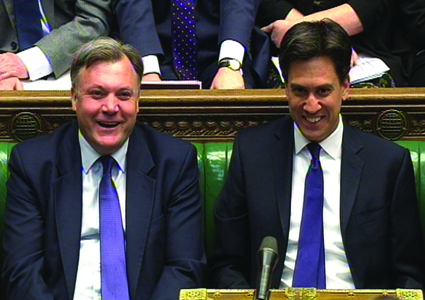
Narcissism of small differences: Ed Balls (left) and Ed Miliband like to tease the "posh" Tories — but they too inhabit a world alien to most voters
The politics of class has returned to Britain — and in Shadow Chancellor Ed Balls Labour has found its chief exponent of class-baiting. Balls will never pass up an opportunity for taunting the Tories about their toffishness and out-of-touch-ness, accusing them of promoting only the interests of their millionaire chums in the City. After March's budget Balls had much fun joshing that class war had broken out within the Conservative Party — between Cameron and his old Etonian coterie on the one hand and the alumni of "minor public schools" such as George Osborne and Michael Gove on the other. By what logic Osborne's alma mater, St Paul's, indubitably one of London's top two independent boys' schools, is a "minor public school" was not explained.
Tony Blair, albeit in the face of some stern resistance and talk of treachery, seemed to have expunged class from the Labour lexicon. During Labour's victorious 1997 election campaign one Labour political broadcast presented a phalanx of business leaders and other wealthy types saying that they now supported Blair and would be voting Labour. In 1998, when he was Secretary of State for Trade and Industry, Peter Mandelson famously said that he was "intensely relaxed about people getting filthy rich". During the 2001 election campaign Blair was interviewed on Newsnight by Jeremy Paxman and was asked: "Do you believe that an individual can earn too much money?" Blair's response was dismissive: "No, it's not a view I have. Do you mean that we should cap someone's income? . . . Why? What is the point? You can spend ages trying to stop the highest-paid earners earning the money but in an international market like today's, you probably would drive them abroad."
Paxman then pressed Blair on why the rich should not pay a higher rate of tax, asking: "Where is the justice in taxing someone who earns £34,000 a year, which is about enough to cover a mortgage on a one-bedroom flat in outer London, at the same rate as someone who earns £34 million. Where is the justice?" Apart from reminding us how much further house prices have risen in London, Paxman's question is exactly the line of argumentation Labour is now using. Blair's response could have come straight from Osborne: "The person who earns £34 million . . . will pay far more tax on the £34 million than the person on £34,000 . . . The fact that you have some people at the top end earning more, fine, they pay their taxes . . . If you end up going after those people who are the most wealthy in society, what you actually end up doing is in fact not even helping those at the bottom end." Blair sums up his attitude with a line which was seen as a betrayal of all that Labour traditionally stood for: "It's not a burning ambition for me to make sure that David Beckham earns less money."
Blair stuck to this position throughout his time as Prime Minister; indeed, Gordon Brown after taking over in 2007 maintained this line for a while before introducing an additional rate of tax of 50 per cent on earnings above £150,000 in 2009, which came into effect in April 2010, just a month or so before the Tories were returned to power. The Labour Chancellor at the time, Alistair Darling, suggested that the additional rate of tax was a temporary measure to offer some counter to the ballooning of the deficit after the 2008 financial crisis and the resultant bailouts.
Today it would be inconceivable for a Labour figure to make statements like Blair's. Instead, the party has reverted to an older narrative of class division. Ed Balls is the driving force behind this move and the party's main line of attack on this government is that it is so wealthy and out of touch that it cannot see the problems faced by ordinary people and, worse, is only interested in promoting the interests of the rich and powerful. Despite the considerable evidence that the Coalition's lowering of the additional rate to 45 per cent in 2013 has increased government revenue, Balls has pledged to restore the 50 per cent rate, come what may.
Like this article? Share, save or print using the icons below:


More Features
- The US Can Still Help Save Syria — and Iraq
- Russian Resurgence has Blindsided Nato
- On Europe, Nothing Less than Treaty Change will do
- Putin has his Useful Idiots on the Left and the Right
- Sarajevo: Where the Century of Terror Began
- Allen Lane’s Pelicans Take Wing Once More
- How Not to Remember the First World War
- Opera is Not Just Our Most Expensive Noise
- Jonathan Miller: One Man, Two Cultures
- Without a Big Idea, Cameron Will Lose
- A Christian Country? No, a Conservative One
- How to Get School Competition Right
- The War on the Firmest Bulwark of our Liberty
- How Modern Liberals Created Nigel Farage
- Caught in the Trap of His Own Metaphysics
- In Search of My Father, Agent of the Comintern
- Geoffrey Hill and the poetry of ideas
- Master of the Glories of the English Country Garden
- Independence Will Do Nothing for Scots
- Bullying and Bluff on the Road to Referendum
Popular Standpoint topics

- Conduct Unbecoming: The Classical Commentaries of Norman Lebrecht in Standpoint
- Propaganda Shouldn’t Pay
- The US Can Still Help Save Syria — and Iraq
- A Putrid Pact between Devils
- Strangers in their own Holy Land
- The Taboo of the Tombola
- Putin has his Useful Idiots on the Left and the Right
- Russian Resurgence has Blindsided Nato
3:05 PM
11:05 AM
8:05 PM
8:05 PM