



It is perhaps not surprising, then, that in 1876, in stipulating his requirements for burial, Newman wanted permanently to leave a sign, redressing the balance, pointing away from himself, towards his community and under the one Cross.
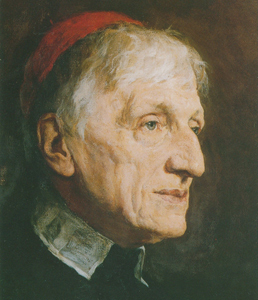
In wishing to be buried in the same grave as Ambrose St John, Newman was conscious of being buried also alongside the adjoining grave of Father Joseph Gordon. Then, in 1878, there followed the death of Father Edward Caswall. His labours had built up the community and the parish from the outset. It was Caswall who, together with Ambrose St John, had taken on so much, and had thereby enabled Newman during the years 1852-8 to spend time in Ireland, not without some cost to the Birmingham community. Newman was never forgetful of the cost paid, both temporally and spiritually, by his brethren. As death approached, he signalled his intention of commemorating their contribution by drawing up a document illustrating his idea of the graves under a cruciform plan. He wished to be buried near the saints, in the plural: in the company of Father Joseph Gordon, Father Edward Caswall, and Father Ambrose St John.
Newman was well aware that in the fourth century St Ambrose had transferred the bones of the martyrs from their burial place to his Milan basilica. The relics of the saints reinforced the Bishop in his mission to the poor and needy. The patronage of the saints was a protection for the city and people in the struggle of the Church against the worldly power. Newman's Oratorian vocation, more-over, committed him to the tradition of St Philip Neri and of Cardinal Baronius. In 16th-century Rome, the Oratorians had revived the practice of the veneration and translation of relics from the catacombs to the churches of the city and beyond. The relics of the martyrs, taken from the catacombs, were transferred to the holy places of Christendom and the newly-emergent territories overseas.
Contact with the relics was contact with Rome; contact with Rome was contact with the early Church; from the Church's holy places, beginning with the tombs of the Apostles and Martyrs, and the basilicas built over them - St Peter's, St Paul's, Santa Croce, San Lorenzo - Christianity had extended from Rome to the barbarian world and, with it, the practice of burial ad sanctos. The shrines of Christendom had become the cradle of Christian
Europe. Now, in the 16th century, a "New Church", the Chiesa Nuova (1575), arose amid the ruins of Rome. Through relics "translated" from the catacombs, Catholic Rome rediscovered its contact with the early Church, Christian Europe recharged its Catholic identity, and a new religious energy linked its missions overseas, in a Communion of Saints uniting the living and the dead. The Christian cosmos was resumed.
All this Newman knew. He had publicised it all his life: first in projecting theLives of the Saints, promoted from Littlemore after 1841, and then under the auspices of the Birmingham Oratory, as a means of awakening the English-speaking world to a history deeper and more truly communitarian than the contemporary Whig interpretation of the English past. To rediscover the saints was to rediscover the holiness of God. God, as the Church proclaimed, was "glorious in His saints".


Post your comment
- The US Can Still Help Save Syria — and Iraq
- Russian Resurgence has Blindsided Nato
- On Europe, Nothing Less than Treaty Change will do
- Putin has his Useful Idiots on the Left and the Right
- Sarajevo: Where the Century of Terror Began
- Allen Lane’s Pelicans Take Wing Once More
- How Not to Remember the First World War
- Opera is Not Just Our Most Expensive Noise
- Jonathan Miller: One Man, Two Cultures
- Without a Big Idea, Cameron Will Lose
- A Christian Country? No, a Conservative One
- How to Get School Competition Right
- The War on the Firmest Bulwark of our Liberty
- How Modern Liberals Created Nigel Farage
- Caught in the Trap of His Own Metaphysics
- In Search of My Father, Agent of the Comintern
- Geoffrey Hill and the poetry of ideas
- Master of the Glories of the English Country Garden
- Independence Will Do Nothing for Scots
- Bullying and Bluff on the Road to Referendum
