



What is now being called Europe’s “migrant crisis” is far more than that. It is in fact a crisis of European thought and of political leadership. At the heart of this crisis are the irreconcilable feelings of the European publics, the problems of a European political class trying to found policies based on those contradictions and a continent-wide unwillingness to think this crisis through beyond short-term emotionalism to any of its logical endpoints.
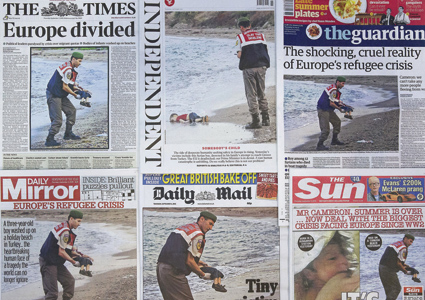 The turning point of the migrant crisis? Front-page coverage of the tragedy of Aylan Kurdi, a Syrian toddler washed up on the Turkish coast (Justin Tallis/AFP/Getty Images)
The first of those problems — the contradictions of the public — has been most evident in recent weeks. In late August, in the eastern German town of Heidenau, there were protests outside a refugee centre and an arson attack on a facility to be used by migrants. The German Chancellor, Angela Merkel, announced that Germany would accept around 800,000 refugees (about 1 per cent of the current German population) this year. When she subsequently appeared in Heidenau, Merkel was roundly booed and heckled by the crowds. This was, understandably, not the image that many other Germans wished to give to the world. Only days later, as refugees flowed across the borders of Germany, there were almost euphoric scenes as people lined the way, clapping, doling out toys and in some places throwing what appeared to be a carnival for their new arrivals. Yet these two groups of people are not wholly separate entities but rather represent a confusion which goes through the heart of many Europeans.
Because of course when we in Europe see people fleeing across borders we think of those who fled from country to country as refugees from Nazi Germany and scoured the globe for anyone to take them in. Our immediate instinct is compassion and, in some cases, guilt. Yet emotion is not enough and little enough, and while journalists compete to find the worst horror stories from those escaping from Syria few people if any are asking the questions behind the emotions.
Here are just a few of the questions we still cannot answer. Is Syria really like Nazi Germany? To date Lebanon, Turkey and Jordan — among other countries — have grudgingly taken in many refugees, but is the choice for Syria’s exiled populations really Europe or death? Even if it was, would Europe be able to take in millions of Syrian refugees? What will we do once they are here? Do we have any jobs for them or places for them to live? If they come here will they ever return to their country, once the war is over? Could “temporary asylum” even exist, given that most people will enter the welfare system and their children access schooling and other undoable provisions? In truth, these questions are the simplest of all. Because that is not the problem in full, but only a portion of it. We are failing to deal with even a portion of the problem.
Of the migrants who now form the largest inflow of migrants into Europe in recent history, only around 40 per cent are Syrians. We have lasered-in on the Syria portion of this problem. But it is only part of the problem. Most of those currently coming into Europe — as I saw on a recent trip to the Italian Mediterranean island of Lampedusa — are from elsewhere in the world, including sub-Saharan Africa and in particular Eritrea. Even if it were in Britain or Europe’s gift to bring peace to Syria, what is the plan to bring stability and prosperity to Eritrea? Has anybody, anywhere got any idea? The British Home Secretary, Theresa May, recently said that Britain and other countries must try to improve living standards in such countries to prevent people coming here. But the truth is — as many studies have shown — it is only when living standards rise (though hardly to luxurious levels) that the migration truly begins. Truly poor people do not have the money to bribe the smugglers.
The turning point of the migrant crisis? Front-page coverage of the tragedy of Aylan Kurdi, a Syrian toddler washed up on the Turkish coast (Justin Tallis/AFP/Getty Images)The first of those problems — the contradictions of the public — has been most evident in recent weeks. In late August, in the eastern German town of Heidenau, there were protests outside a refugee centre and an arson attack on a facility to be used by migrants. The German Chancellor, Angela Merkel, announced that Germany would accept around 800,000 refugees (about 1 per cent of the current German population) this year. When she subsequently appeared in Heidenau, Merkel was roundly booed and heckled by the crowds. This was, understandably, not the image that many other Germans wished to give to the world. Only days later, as refugees flowed across the borders of Germany, there were almost euphoric scenes as people lined the way, clapping, doling out toys and in some places throwing what appeared to be a carnival for their new arrivals. Yet these two groups of people are not wholly separate entities but rather represent a confusion which goes through the heart of many Europeans.
Because of course when we in Europe see people fleeing across borders we think of those who fled from country to country as refugees from Nazi Germany and scoured the globe for anyone to take them in. Our immediate instinct is compassion and, in some cases, guilt. Yet emotion is not enough and little enough, and while journalists compete to find the worst horror stories from those escaping from Syria few people if any are asking the questions behind the emotions.
Here are just a few of the questions we still cannot answer. Is Syria really like Nazi Germany? To date Lebanon, Turkey and Jordan — among other countries — have grudgingly taken in many refugees, but is the choice for Syria’s exiled populations really Europe or death? Even if it was, would Europe be able to take in millions of Syrian refugees? What will we do once they are here? Do we have any jobs for them or places for them to live? If they come here will they ever return to their country, once the war is over? Could “temporary asylum” even exist, given that most people will enter the welfare system and their children access schooling and other undoable provisions? In truth, these questions are the simplest of all. Because that is not the problem in full, but only a portion of it. We are failing to deal with even a portion of the problem.
Of the migrants who now form the largest inflow of migrants into Europe in recent history, only around 40 per cent are Syrians. We have lasered-in on the Syria portion of this problem. But it is only part of the problem. Most of those currently coming into Europe — as I saw on a recent trip to the Italian Mediterranean island of Lampedusa — are from elsewhere in the world, including sub-Saharan Africa and in particular Eritrea. Even if it were in Britain or Europe’s gift to bring peace to Syria, what is the plan to bring stability and prosperity to Eritrea? Has anybody, anywhere got any idea? The British Home Secretary, Theresa May, recently said that Britain and other countries must try to improve living standards in such countries to prevent people coming here. But the truth is — as many studies have shown — it is only when living standards rise (though hardly to luxurious levels) that the migration truly begins. Truly poor people do not have the money to bribe the smugglers.
Like this article? Share, save or print using the icons below:


More Features
- Debunking the EU Referendum Myths
- Britain's Opportunity Is Europe's Warning
- Controlling Immigration Is Good For Democracy
- The Pied Piper of Islington
- The West Cannot Afford To Ditch Nato
- End Of History — Or Clash Of Civilisations?
- We Can Defeat Islamist Terror — But Not On Our Own
- Without the Emperor, What is Left of Old Japan?
- Now Or Never
- Who Will Heal This Divided Country?
- What Made The West Great Is What Will Save Us
- Shock And Awe: Tales Of A Washington Insider
- We Shouldn't Let Old Men Rot Away In Jail
- Arnold Wesker’s Bid To Build A New Jerusalem
- Our EU Deal Gives Us The Best Of Both Worlds
- Brexit Would Save Us And Set Europe An Example
- Are Both Sides Playing By The Referendum Rules?
Popular Standpoint topics

9:01 PM
5:12 AM
11:11 PM
7:11 PM
11:11 PM
8:11 PM
8:11 AM
1:10 PM
11:10 PM
2:09 AM