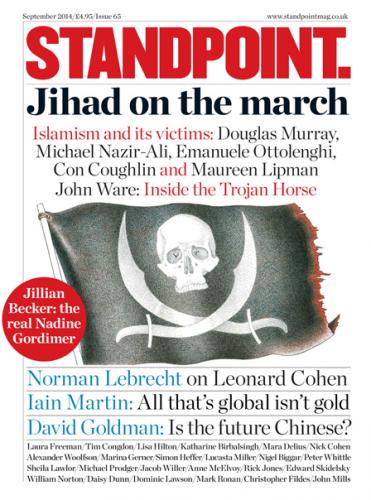



Nor did an angry official from PEN, an organisation dedicated to protecting writers from censorship, march on to the stage to tell Ramadan that if he wanted to talk about "targets" and "racism" then he ought to remember Ayaan Hirsi Ali had been targeted by Islamists trying to inflict the ultimate form of censorship on her. She first received death threats after protesting against the "honour killings" and female genital mutilations inflicted on immigrant women in Holland. She made a short film with the Dutch director Theo van Gogh in which he projected misogynist verses from the Koran on to the bodies of actresses playing abused women. For this, Mohammed Bouyeri slaughtered him in the street. With his dagger he pinned a raving letter to Hirsi Ali on to the bloodied corpse. Over five sheets, he explained that she must die because she was "a soldier of evil" doing the work of her "Jewish masters".
Ayaan Hirsi Ali was a Somali asylum-seeker from a Muslim family. By speaking out against the oppression of women, she underwent a supernatural transformation. In the eyes of her potential murderers, she at once became a Jew or a Jewish dupe, the agent of a diabolical, and familiar, conspiracy by the Elders of Zion to annihilate Islam and control the world. Ever since, she has had to live with that threat that other murderers will make good on Bouyeri's promise to kill her. When I last saw her in London, an IRA man who had gone over to the British side was using his knowledge of the terrorist mind to organise her security. No one present thought she was being over-cautious or that he was making a fuss about nothing.
Her plight is well known, even in Manhattan, but not one timorous voice objected to Ramadan accusing a woman whose friend had been murdered by racists and who still needed security guards to protect her from racists, of being close to being a racist herself. The audience instead gave him a hearty round of applause.
The unthinking immorality of their reaction, its parochialism and boorishness, provides a fitting backdrop to the controversy about how Western liberals are responding to the challenge of armed and belligerent reaction. Ramadan and Hirsi Ali both have new books out. Meanwhile, Paul Berman has produced a lucid assault on the double-dealing of the Anglo-American intelligentsia. He weaves its response to Ramadan and Hirsi Ali into the history of how Ramadan's grandfather, Hassan al-Banna, mingled the ideas of European fascism with religion in the early years of the Muslim Brotherhood to produce the one of the first authentically Islamist movements. Berman's Flight of the Intellectuals (Melville House) has in turn provoked a furious and unintentionally revealing reaction from the New York literary press, which I have no doubt will have led a delighted Berman to hug himself and say "I told you so".


- The Plot to Islamise Birmingham’s Schools
- Nigeria, Iraq, Gaza—The Threat is the Same
- Radical Islam and its Invisible Victims
- The Man Who Tried to Teach us all a Lesson
- Globalisation and The Crisis of the Nation State
- The Medium Isn’t Always the Message
- What sort of Europe does Cameron Want?
- Is China outstripping the West at innovation?
- Piketty’s panacea will make inequality worse
- The Moral Strength of Leonard Cohen
- Designer who taught us to keep it simple
- The US Can Still Help Save Syria — and Iraq
- Russian Resurgence has Blindsided Nato
- On Europe, Nothing Less than Treaty Change will do
- Putin has his Useful Idiots on the Left and the Right
- Sarajevo: Where the Century of Terror Began
- Allen Lane’s Pelicans Take Wing Once More
- How Not to Remember the First World War
- Opera is Not Just Our Most Expensive Noise
- Jonathan Miller: One Man, Two Cultures

11:08 AM