


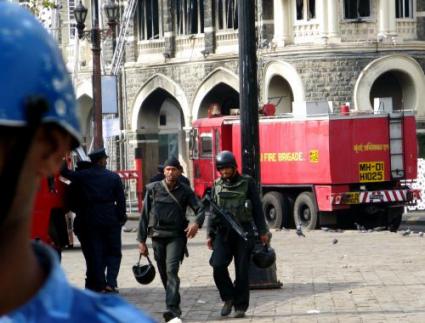
It is all too clear that the Mumbai terrorists were outstanding at their vocation. This was true in a purely technical military sense - after all, as few as ten of them were able to hold off the massed might of India's security forces, including her best commandos, for more than three days. But it was also true in a more important functional sense: they were highly effective at inspiring terror. They chose precisely the right targets in a country whose institutional and cultural weaknesses they understood and were able to exploit. Though the real horror of their attacks was the murders they committed and tried to commit, they inspired massive fear far away from the symbolic targets they chose. Indeed, what I found in Mumbai during the four long days of the emergency was that the fear they provoked increased the further you got from the loci of their actual attacks.
The terror instilled by the attacks was somehow deepened by the news coverage, with its melodramatic music, its repetition of rumours and supposition, and its sheer ghoulish relentlessness. But the terror seemed from my experience to have a proportionately stronger effect on the well-off and socially prominent. The poor of the city, like the inhabitants of Colaba Market in south Mumbai, where three of the attacks took place, are perhaps more fatalistic and resilient, having dealt with life-threatening floods, riots and terrorist attacks before. Mumbai's working- and middle-class commuters were back on the trains the day after the horrific railway bombings of July 2006. This time, smart shops stayed closed not just in Colaba but far away in central Mumbai, and hundreds of thousands, perhaps millions, stayed home, glued to their TVs for days on end.
Thursday, November 27
I get to Mumbai (almost all residents still call it Bombay even though they have long called themselves Mumbaikars) in the evening, about 24 hours after the terrorists attacked. After walking through the gleaming but half-empty airport terminal, I find it all but impossible to get a cab down to my hotel in Colaba. The drivers are convinced either that the south of the Mumbai peninsula is too dangerous or that a police curfew has cut off all road access to the area. As my hotel has reassured me, it turns out that no such cordon or curfew exists. The one brave driver willing to take a German businessman and me makes it down to the bottom of the peninsula in a quarter of the usual time. Despite the fact that the emergency is at its height, there are no roadblocks except in the immediate vicinity of the Taj Mahal and Oberoi hotels. Indeed, when I drop the German at his seaside apartment, we go straight through a police checkpoint that has apparently been abandoned. "Oh, the police always leave the checkpoints at midnight to go to sleep," the businessman tells me. "Security was supposed to have been boosted because they were expecting attacks here after the bombs in Jaipur and Bangalore, especially during Diwali [in early November], but nothing really changed."


- Admit It, Mr Kerry: You Blundered
- Bismarck Versus Blair — A Foreign Policy Crossroads
- Arab Spring, Islamist Summer — What Next?
- The Diplomat the Whole World Ignores
- The Blob Has Run Schools For Decades. Not Any More
- Would You Intervene — Or Pass On The Other Side?
- He Died That Others Might Live In Peace
- The Hero's Journey is Hollywood's McMyth
- Online Only: Countering the Counter-Jihadists
- Online Only: The Price Paid for Criticising Islam
- 'Please Sir, I Just Want to Learn More'
- Why Students Should Be Glad To Pay Tuition Fees
- A 'Liberal Racist'? Me? I Felt Like a Heretic
- Demolish the Relics of Yesterday's Future
- Was Britain Right To Go To War In 1914?
- German Victorians Who Helped Transform Britain
- The Alternative History of an Undivided India
- Online Only: Heirs to the Left
- ONLINE ONLY: The Hayward Gallery's Fashionable Primitives
- ONLINE ONLY: A Spiritual Corner of Southwark

- The Zombie Argument that Refuses to Die
- Online Only: The Price Paid for Criticising Islam
- Overrated: Dan Brown
- Is the Brain the Key to Understanding Religion?
- Overrated: George Monbiot
- Time to Wise Up to the Muslim Brotherhood
- 'Please Sir, I Just Want to Learn More'
- The Alternative History of an Undivided India
- The Zombie Argument that Refuses to Die
- Online Only: The Price Paid for Criticising Islam
- Overrated: Dan Brown
- Is the Brain the Key to Understanding Religion?
- Overrated: George Monbiot
- Time to Wise Up to the Muslim Brotherhood
- 'Please Sir, I Just Want to Learn More'
- The Alternative History of an Undivided India
- Decline and Fall of the History Men
- Uncritical Theorists Who Misread the Nazis
- The Zombie Argument that Refuses to Die
- The Banality of Hannah Arendt
- From Kitsch to Cool: Picasso and Modern Art
- Is the Brain the Key to Understanding Religion?
- Time to Wise Up to the Muslim Brotherhood
- Midfield Virtuoso Finds His Perfect Pitch
7:09 AM
7:08 AM
12:02 AM
6:09 AM
7:01 AM
12:01 PM
7:01 PM
6:01 PM