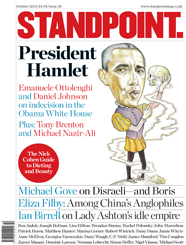



Emanuele Ottolenghi's book, Under a Mushroom Cloud: Europe, Iran and the Bomb (Profile Books), deals with Tehran's pursuit of a nuclear capability and its consequences for peace and stability in the Middle East.
Ottolenghi, an Italian scholar who also writes a monthly column for Standpoint, shows that the Iranian programme has all the hallmarks of a scheme designed to produce nuclear weapons. Yet the International Atomic Energy Agency (IAEA) is unable to say so with certainty, while successive US administrations have been unable to produce a "smoking gun". In fact, one American National Intelligence Estimate (NIE), published in 2007, even suggested that Tehran might have abandoned key aspects of the programme.
The key powers have tried to deal with the problem by kicking it into the long grass.
Ottolenghi shows that the European Union has done so by initiating endless talks with Tehran. The idea is that as long as one is talking, one need not worry. The Americans have tried to deal with the issue by periodical threats and the imposition of largely symbolic sanctions. President Obama has just extended sanctions on Iran for a year, presumably absolving himself from doing anything else on the issue for a further 12 months. He has also announced that he would follow President George W. Bush by sending an emissary to the forthcoming talks between Iran and the so-called 5+1 group - the US, UK, France, Russia, China and Germany.
The Russians feel no need to do anything, hoping that, if the mullahs do real mischief, the Americans will deal with it. The Arabs are caught between a rock and a hard place. They fear a nuclear-armed Iran but are unwilling to help stop the bomb by defying the mullahs and risking retaliation. Instead, they are launching their own nuclear programmes, thereby contributing to a new era of proliferation. Saudi Arabia, the United Arab Emirates, Iraq, Syria and Egypt have already announced nuclear programmes, ostensibly for civilian purposes. In effect, everyone hopes the problem will just go away.


Post your comment
- Admit It, Mr Kerry: You Blundered
- Bismarck Versus Blair — A Foreign Policy Crossroads
- Arab Spring, Islamist Summer — What Next?
- The Diplomat the Whole World Ignores
- The Blob Has Run Schools For Decades. Not Any More
- Would You Intervene — Or Pass On The Other Side?
- He Died That Others Might Live In Peace
- The Hero's Journey is Hollywood's McMyth
- Online Only: Countering the Counter-Jihadists
- Online Only: The Price Paid for Criticising Islam
- 'Please Sir, I Just Want to Learn More'
- Why Students Should Be Glad To Pay Tuition Fees
- A 'Liberal Racist'? Me? I Felt Like a Heretic
- Demolish the Relics of Yesterday's Future
- Was Britain Right To Go To War In 1914?
- German Victorians Who Helped Transform Britain
- The Alternative History of an Undivided India
- Online Only: Heirs to the Left
- ONLINE ONLY: The Hayward Gallery's Fashionable Primitives
- ONLINE ONLY: A Spiritual Corner of Southwark

- The Zombie Argument that Refuses to Die
- Online Only: The Price Paid for Criticising Islam
- Overrated: Dan Brown
- Overrated: George Monbiot
- Is the Brain the Key to Understanding Religion?
- 'Please Sir, I Just Want to Learn More'
- An Assault on Free Speech at the LSE
- The Alternative History of an Undivided India
- The Zombie Argument that Refuses to Die
- Online Only: The Price Paid for Criticising Islam
- Overrated: Dan Brown
- Overrated: George Monbiot
- Is the Brain the Key to Understanding Religion?
- 'Please Sir, I Just Want to Learn More'
- An Assault on Free Speech at the LSE
- The Alternative History of an Undivided India
- Decline and Fall of the History Men
- Uncritical Theorists Who Misread the Nazis
- The Zombie Argument that Refuses to Die
- The Banality of Hannah Arendt
- From Kitsch to Cool: Picasso and Modern Art
- Is the Brain the Key to Understanding Religion?
- Time to Wise Up to the Muslim Brotherhood
- Midfield Virtuoso Finds His Perfect Pitch