


The third dimension was a new narrative. As I said, I believe that in politics and certainly within religion part of leadership is to be able to tell a narrative that explains a generation to itself. I learnt this from the Harvard educationalist and psychologist Howard Gardner, hence my definition of Judaism, and the pun in the book's title is that it's the civilisation whose Golden Age is in the future, Judaism is the voice of hope in the conversation of human kind. How do I exemplify this? Through Israel. I mention that my great-grandfather built the first house in the town which today is the sixth largest in Israel: Petach Tikva, the "Gateway of Hope" — a phrase from the prophet Hosea. The Jews I've had the privilege of knowing, many of whom are Holocaust survivors, did not look back. They looked forward. They built lives for themselves. They built a country together and they defended it against all enemies. They sustained a free press and independent judiciary, they wove together Jews from virtually every country under the sun — the last time I looked it was 103 countries speaking 82 languages. Israel is the home of hope. We've always played that role, at least in Western civilisation, of the alternative voice, the counter-voice.
We are living in a century in which the major crises are: the environment; asylum seekers; the growing inequality between First- and Third-World economics; maintaining democracies in parts of the world that never had a tradition of it. And there is Israel — the very first settlers of my great-grandfather's generation, before the word "Zionism" was coined, their first act was to reforest the land. Second, Israel was made out of asylum seekers — mostly Jewish, but not all by any means — and the only other country to be made wholly out of asylum seekers was the US. Third, Israel, with no natural resources, turned a Third-World economy into one at the cutting edge of information technology, nano-technology, medical science and agricultural science. It showed you can make the transition. Fourth, most of the Jews who went to Israel came from places in which democracy was totally unknown. But there was never an argument over whether or not the state would be a democracy — it was taken for granted. There wasn't ever a question that women would have the vote. They weren't given the vote in England until 1918. Yes, they asked some rabbis, and most of the rabbis said no, but luckily not too many people listen to rabbis too much of the time, otherwise we might be in more problems than we are now.
DJ: You write that after 9/11, your children told you that for the first time they'd actually experienced anti-Semitism. You yourself had not really suffered this in your younger days, but that now, in middle age, you've been forced to acknowledge that it is out there, in a new mutation, even in a country such as Britain where you'd always felt safe. You write that so much of Jewish history is about people losing battles. How do you avoid despair?
JS: Losing battles is good for the soul. I went to two Christian schools where, had there been any anti-Semitism floating around, my antennae are sensitive enough to pick it up. I did not experience one instance of anti-Semitism throughout my school and university years. I was taught by some remarkable people, from Roger Scruton to the late Bernard Williams, which was an extraordinary privilege. I never experienced any anti-Semitism: to the contrary, I experienced a lot of respect. To me, that was a lesson that I will never cease to be grateful for, and it's made me very easily able to have quite deep friendships with Christian and non-Christian leaders in Britain and beyond.
It's also the single greatest heritage of Britain that it must never lose. Britain was not always perfect. No country ever is, but the Jews who came here loved this country above all for its tolerance. I officiated a couple of weeks ago at the stone-setting of a former president of the United Synagogue, George Gee, and it says on his gravestone: "A proud Englishman and a proud Jew." That was the English heritage from Sir Moses Montefiore all the way through to the present. And we must never lose it.


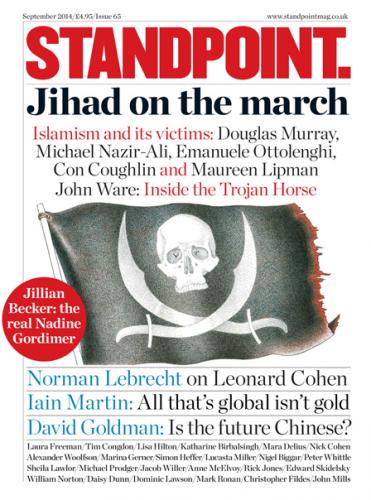
- The Plot to Islamise Birmingham’s Schools
- Nigeria, Iraq, Gaza—The Threat is the Same
- Radical Islam and its Invisible Victims
- The Man Who Tried to Teach us all a Lesson
- Globalisation and The Crisis of the Nation State
- The Medium Isn’t Always the Message
- What sort of Europe does Cameron Want?
- Is China outstripping the West at innovation?
- Piketty’s panacea will make inequality worse
- The Moral Strength of Leonard Cohen
- Designer who taught us to keep it simple
- The US Can Still Help Save Syria — and Iraq
- Russian Resurgence has Blindsided Nato
- On Europe, Nothing Less than Treaty Change will do
- Putin has his Useful Idiots on the Left and the Right
- Sarajevo: Where the Century of Terror Began
- Allen Lane’s Pelicans Take Wing Once More
- How Not to Remember the First World War
- Opera is Not Just Our Most Expensive Noise
- Jonathan Miller: One Man, Two Cultures

8:10 PM
1:03 AM
7:10 AM