


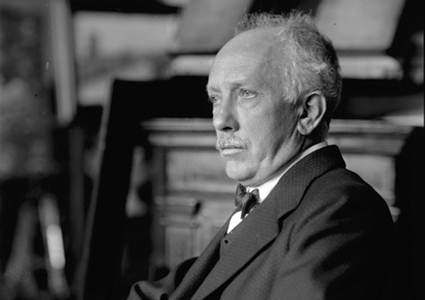
 Richard Strauss in 1922: A boor and a timeserver in life, but never a boor in his music
Music aside, the man was a self-indulgent boor, his life a string of platitudes. How the universal sound worlds of Salome and the Four Last Songs can have arisen from so dreary a human source is an unfathomable mystery of creation.
Unless, that is, we require all authors of great work to manifest an equivalent greatness, to be in some way larger and more colourful than their humdrum lives — the mindset that, in a highly acclaimed recent biography, prompts John Eliot Gardiner to ascribe failings of "what we would call anger management" to Johann Sebastian Bach, a bias of blame that aims both to elevate and to humanise an incomprehensible ideal.
Richard Strauss was no raging Bach. Search his long life end to end, 1864 to 1949, and you will find no flare of passion, no situation in which he ever lost urbane control of his stolid Bavarian manners. The son of a Munich orchestral horn player and a brewery heiress (his father, who played in Wagner premieres, must have thought he'd wedded Valhalla), the young Richard never had a formal music lesson, relying on a familiarity with the family craft to compose pieces of precocious sheen, catchy themes and narrative thrust. He knew the limits of what an audience would bear.
He was 24 when Don Juan was performed at Weimar, the first in a series of fashionable tone poems with graphic titles-"Death and Transfiguration", "Till Eulenspiegel's Jolly Pranks", "Thus Spake Zarathustra", "Don Quixote", "A Hero's Life". Strauss at this stage aimed for feminine fantasies, the beer garden, the numinous and the Nietzschean. He was nothing if not eclectic, always market-oriented.
As a conductor in Weimar, he led the first production of Humperdinck's Hansel and Gretel, a Wagnerian opera for terrorised children. At 30 he married Pauline, a general's soprano daughter and at 34 he became chief conductor at the court opera in Berlin, sharing with Gustav Mahler in Vienna a dominance of the German-speaking opera stage.
But where the excitable Mahler imagined that he and Strauss were allies, "like two miners tunnelling a mountain from opposite sides, destined to meet in the middle", Strauss shared few of his friend's progressive ideals. Where Mahler put his job on the line in a bid to stage salacious Salome, Strauss played safe with his programming. Where Mahler ended an opera in migraine-stricken exhaustion, Strauss declared that a conductor who broke sweat was no better than an amateur. Where Mahler saw redemption in art, Strauss said: "I don't know what I am supposed to be redeemed from. When I sit at my desk in the morning and an idea comes into my head, I surely don't need redemption. What did Mahler mean?"
A man of regular habits, guarded by a dragon wife, Strauss's ambitions were social and pecuniary. Of the striptease dance in Salome, scandalous as much for its heresy as its nudity, he would say, blithely, "The damage built me a house in Garmisch." Behind the opera's notoriety, he stretched tonality almost to snapping point in a climactic, clashing F chord. For a brief moment, he led the avant-garde. In 1909, he toyed again with dissonance in Elektra, the first of five joint ventures with the poet Hugo von Hofmannstal, only to retreat in Der Rosenkavalier to the deep, deep comfort of lush harmonies, replacing the dangerous pathologies of his two previous operas with a nudge-wink sexual suggestiveness.
Like this article? Share, save or print using the icons below:


- Conduct Unbecoming: The Classical Commentaries of Norman Lebrecht in Standpoint
- Propaganda Shouldn’t Pay
- The US Can Still Help Save Syria — and Iraq
- A Putrid Pact between Devils
- Strangers in their own Holy Land
- The Taboo of the Tombola
- Putin has his Useful Idiots on the Left and the Right
- Russian Resurgence has Blindsided Nato
4:04 AM
3:04 PM
6:04 AM
11:04 PM
2:04 PM
9:04 AM
10:03 PM
8:03 PM
8:03 PM
7:03 PM