



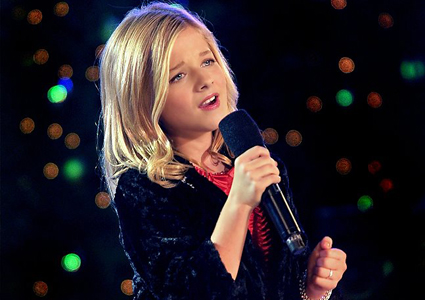
Jackie Evancho:Ten-year-old star of "America's Got Talent" in 2010 whose fans behave as though her performances are above criticism
A child blinks into television lights. Nine years old and small for her age, her sober expression mocks the synthetic grins and trivial putdowns of the toothy celebrities who are to judge her. The conversation is short; there are no jokes to be milked from an infant. Asked what she intends to sing, the little girl names an opera aria, "O Mio Babbino Caro", mouthing each syllable with a strong Dutch accent and exaggerated care. Celebrity mouths are seen to pucker: ooh, opera, posh.
A minute later, amid pinch-me shrieks from the studio audience, the camera pans back to the judges, their painted lips mouthing, "Wow!", "Amazing!". The stunt has worked, again. Another star is born. Millions click on YouTube. Ching go the tills.
No point in naming the girl at this point. A dozen epiphanies of this nature have occured on global TV in franchised brands of Got Talent, X Factor and lesser variants of the Roman emperor's raised finger. At this late moment in human decadence, it appears that nothing quite moves the public heart as the sight and sound of a bare-kneed infant simulating adult actions and emotion, set to music.
A telephone salesman might pass in the murk for Pavarotti, a Scottish spinster may credibly "Dream a dream", but when the votes are in and the last potato has left the living-room couch, what the collective unconscious registers is the act of an angelic child performing far above and beyond her wit and experience.
I use the adjective with reluctance. Angels are what the headline writers call Amira Willighagen, nine-year-old winner of Holland's Got Talent whose opera album is out this month, and her predecessor Jackie Evancho, runner-up at ten years old in the 2010 America's Got Talent show and a classical chart-topper ever since.
The noun places them in an ethereal realm, above criticism. Writers who review child performers by means of rational analysis, and voice teachers who use genre comparison, find themselves abused online for the twin sins of denying a heavenly being and attacking a vulnerable child. The God-child myth is alive and well in 21st-century America, operating in an informal coalition with the child-protection lobby. Our critical faculty has been dangerously disabled.
My colleague Tim Page was forced into virtual hiding after writing this cool-headed assessment of Jackie Evancho in the Washington Post: "Her interpretation seems little more than imitation — almost ventriloquism — with scarcely a trace of originality. She is comfortable only within a small range. The rest of the time, she is reaching hard for high notes or scooping for low ones. Her phrasing is shaky and unsure; her anxiety is palpable; there is nothing ‘easy' or free-flowing about her performance. All in all, figuratively speaking, one has the sense that she is trying very hard to fill gigantic shoes that may well fit her someday but could easily wreck the way she walks if she persists in wearing them now."
Tim's observations are shrewd, his predictions faultless. No singer in modern times has ever made an opera career from a childhood launch. These children are not opera divas in the making, whatever else they may achieve in the future. Some child singers go on to great things, others to grim ends. Michael Jackson and his siblings made epic pop careers. Shirley Temple became US ambassador to Ghana and Czechoslovakia. Charlotte Church, sprung as a classical soprano, is now a media star. Lena Zavaroni hit anorexia at 13 and died at 35.
Like this article? Share, save or print using the icons below:


- Conduct Unbecoming: The Classical Commentaries of Norman Lebrecht in Standpoint
- Propaganda Shouldn’t Pay
- The US Can Still Help Save Syria — and Iraq
- A Putrid Pact between Devils
- Strangers in their own Holy Land
- The Taboo of the Tombola
- Putin has his Useful Idiots on the Left and the Right
- Russian Resurgence has Blindsided Nato
1:05 AM
8:05 PM
6:05 PM
5:05 PM
5:05 PM
7:05 AM
7:05 AM