


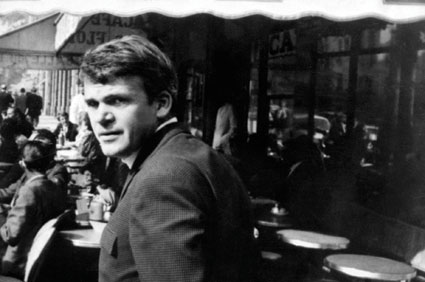
Milan Kundera in Paris in 1975, a year after he emigrated from his homeland (Getty)
Milan Kundera, arguably the most brilliant literary anatomist of communism in Eastern Europe, was accused last October in the liberal Czech magazine Respekt of having informed on one of his countrymen in 1950, leading to that man's imprisonment for 14 years in a hard labour camp. Because Kundera's stature rests largely upon his having been a voice of sanity and morality in the Cold War, there is no small measure of tragedy and irony here. The controversy has drawn angry disbelief from international literati and equally angry protests from journalists that even anti-Stalinist novelists are not above the scrutiny of history.
In 1948, a putsch in Czechoslovakia led to a communist takeover. As a result, the armed forces were purged, and since 40 per cent of the Czech Air Force were pilots who had flown with the RAF in the war, that branch was heavily reduced. Veteran airmen were demoted, tossed out or sent to labour camps due to their exposure to the West. But even students were subject to penalties. Two, Miroslav Dvoracek and Miroslav Juppa, were boyhood friends who had attended the same school in a small town in Eastern Bohemia and dreamed about becoming pilots. In a memorandum from January 1949, they were included on a list of expulsions from their class at the Air Force Academy because of their supposed "negative attitude to the democratic system of our state but also...their open opposition to the state and the party". Ordered a month later to join an infantry unit, Dvoracek and Juppa went AWOL and, with the help of Juppa's girlfriend Iva Militka and her relatives, fled to West Germany.
They arrived at the Leopold Barracks refugee camp in Munich, which then housed about 150,000 displaced persons. Given the presence of US and Soviet intelligence agents in Germany at the time, they were courted by both sides for espionage work. But, being pro-Western, they found themselves being trained as couriers by General Frantisek Moravec, the head of intelligence for the Czechoslovak Government in Exile, who had previously been responsible for keeping Prague's best out of German hands in 1939. In exchange for clandestine work, Dvoracek and Juppa made Moravec promise to reinstate them in the air force upon the eventual demise of the Stalinist regime. The newly-minted spies' first assignment came shortly after Christmas 1949. They stole back through the Bohemian Forest, and Dvoracek was instructed to contact a chemical engineer named Vaclavik, who was going to report to the Americans on the status of his industry. Sensing that he was being followed, Dvoracek panicked and returned to Germany.


Post your comment
- Licence To Chill? Not Yet, Prime Minister
- Money Can't Buy Us Love: Profiting From Loneliness
- More Immigration Means Less Integration
- Is France As Doomed As Houellebecq Thinks?
- Compassion To Refugees, Not Capitulation To Islamic State
- How Mervyn King Got Northern Rock Wrong
- Fix Rotten Boroughs Or Risk Voting Wars
- Migrant Crisis? Europe Hasn't Seen Anything Yet
- Why Palmyra Should Matter To The West
- Corbyn's Rise Makes Cameron Redundant
- No, Jeremy: Politics Is All About Borders Now
- Why 'Lady Chatterley' Still Provokes Us
- For Climate Alarmism, The Poor Pay The Price
- Will Putin's Empire Outlast The Soviets?
- British Witnesses To Lenin's Revolution
- Bibliophiles Beware: Online Prices Are A Lottery
- How Jeremy Corbyn's Coup Hijacked Labour
- Corbyn's Signpost Back To The Ghetto
- Unionists, Don't Despair: Scotland Is Not Lost — Yet
- Britain's Apologists For Child Abuse
