




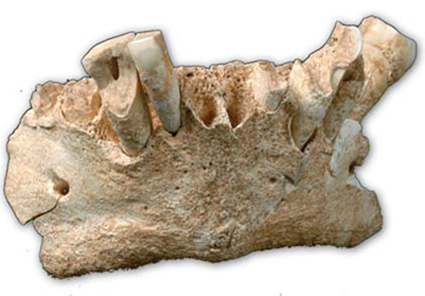
Jaw, jaw: Can you spot the design defect?
Can one believe in evolution and God? Some people of faith and some scientists agree: "No." They are wrong. The theory of evolution says that organisms are related by descent from common ancestors. Over time, organisms change and diversify as they adapt to different environments. Species that share a recent common ancestor are more similar to each other than species whose last common ancestor is more remote. Thus, humans and chimpanzees are, in configuration and genetic make-up, more similar to each other than they are to baboons, elephants or kangaroos.
If humans came about by evolution, then the Bible isn't wrong when it says that humans were created in the image of God.
Science has many other theories besides evolution. The heliocentric theory says that the earth revolves around the sun rather than vice versa. The atomic theory says that all matter is made up of atoms. And astronomy teaches us that the galaxies expand in space and that stars and planets form over time. Scientists agree that the evolutionary origin of plants and animals is a scientific conclusion beyond reasonable doubt. They place it beside such established notions as the roundness of the earth, its revolution around the sun and the atomic composition of matter. That evolution has occurred is, in ordinary language, a fact, not just a theory.
Many Biblical scholars have rejected a literal interpretation of the Bible as untenable because it contains mutually incompatible statements, if they are taken as scientific. The beginning of Genesis presents two different creation stories. Extending through chapter one and the first verses of chapter two is the six-day narrative, in which God creates human beings — both "male and female" — in His own image on the sixth day, after creating light, earth, firmament, fish, fowl and cattle.
In Genesis 2:4, a different narrative starts: God first creates a male human, then plants a garden and creates the animals and only then proceeds to take a rib from the man to make a woman. Which one of the two narratives is correct and which one is in error? Neither contradicts the other, if we understand the two narratives as conveying the same message, that the world was created by God and that humans are His creatures.
There are numerous inconsistencies and contradictions in the Bible. For example, in the description of the return from Egypt to the promised land by the chosen people of Israel, not to mention erroneous factual statements about the sun circling the earth and the like. Is the Bible "wrong"?
Biblical scholars hold that the Bible is inerrant regarding religious truth, not in matters that are of no significance to salvation. St Augustine, one of the greatest Christian authors of all time, wrote: "In the matter of the shape of heaven, the sacred writers did not wish to teach men facts that could be of no avail to their salvation."
He is saying that Genesis is not a book of astronomy. He also noted that in Genesis's narrative of creation, God created light on the first day but did not create the sun until the fourth day, concluding that "light" and "days" in Genesis made no literal sense. The Bible is about religion. It isn't the purpose of its authors to settle scientific questions.
Other religious scholars and authorities have made similar statements. In 1981, Pope John Paul II asserted that the Bible "speaks to us of the origins of the universe and its make-up, not in order to provide us with a scientific treatise but in order to state the correct relationships of man with God and with the universe. Sacred Scripture wishes simply to declare that the world was created by God. Any other teaching about the origin and make-up of the universe is alien to the intentions of the Bible, which does not wish to teach how heaven was made but how one goes to heaven."
If evolution is true, it does not follow that humans were not created by God. Science and faith speak about different aspects of reality. An individual human develops from a single cell in the mother's womb, is born, grows into an adult and eventually dies. A person of faith can accept these natural processes and still believe a human to be a creature of God.
The scholarly Protestant theologian A. H. Strong wrote in 1885: "We grant the principle of evolution, but we regard it as only the method of divine intelligence." He explained that the brutish ancestry of humans was not incompatible with their excelling status as creatures in the image of God. Yes, one can believe in both evolution and God. Evolution is a well-confirmed scientific theory. Christians and other people of faith need not see evolution as a threat to their beliefs. Like Strong, many theologians see evolution as the process by which God creates the wonderful diversity of plants, animals and other living beings.
Science and religious beliefs need not be in contradiction because science and religion concern different matters. Science concerns the processes that account for the natural world: the composition of matter, the expansion of the galaxies and the origin and diversity of organisms. Religion concerns the proper relation of people to their creator and to each other, the meaning and purpose of human life and of the world and how to live a virtuous life.
Science and religion can be, for people of faith, mutually motivating and inspiring. Science may inspire religious beliefs and religious behaviour, as we respond with awe to the immensity of the universe, the wondrous diversity of organisms, and the marvels of the human brain and the human mind.
Religion promotes reverence for the creation, for humankind as well as the environment. Religion may be a motivating force and source of inspiration for scientific research and may move scientists to investigate the marvellous world of the creation and to solve the puzzles with which it confronts us.
The natural world abounds in catastrophic disasters, imperfections, dysfunctions, suffering and cruelty: tsunamis bring destruction and death; volcanic eruptions erased Pompeii and Herculaneum, killing all their citizens; and floods and droughts bring ruin to farmers.
The human jaw is poorly designed, so that the wisdom teeth need to be extracted and the other teeth benefit from being straightened; lions devour their prey; malaria parasites kill millions of humans every year and make 500 million sick.
The scientific revolution, ushered in by Copernicus, Galileo and Newton, provided a natural explanation of the calamities of the physical world: tsunamis, earthquakes and volcanic eruptions occur as a result of natural processes. They need not be attributed to specific actions of the Creator directed to punish some humans and reward others.
Similarly, the theory of evolution, ushered in by Darwin's revolution, accounts for the imperfections, dysfunctions and cruelties of the living world. They are a consequence of the clumsy ways of the evolutionary process.
Evolution is not the enemy of religion but, rather, it can be its friend, because it accounts for disease, death, and the dysfunctions and cruelties of living organisms as the result of natural processes, not as the specific design of God. The God of revelation and of faith is a God of love and mercy, and of wisdom.
Darwin's theory of evolution is a gift to science — and to religion as well.


8:05 PM
7:05 PM
7:05 PM
3:05 PM
2:05 PM
2:05 PM
1:05 PM
1:05 PM
1:05 PM
1:05 PM