



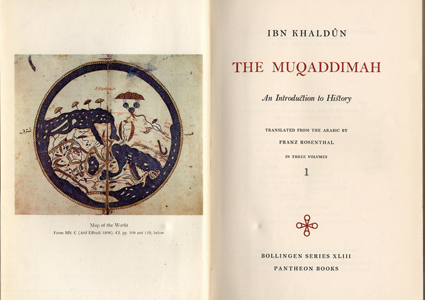
Pioneer of sociology: In his philosophy of history, Ibn Khaldun recognised the value of "Asabiyah" (social cohesion)
It is not clear that the West has successfully met the challenge of 9/11. Worse: it is not clear that the West yet fully understands what the challenge is.
To understand 2001 we have to go back to 1989, the year of the collapse of the Soviet Union, the end of the Cold War, and the fall of the Berlin Wall. It was an historic moment that few had expected. What did it mean? It was then that two stories were born, with one of which we are familiar, the other of which we seem hardly to know or understand at all.
The first narrative was that the West had won. Communism had imploded. In the end, it failed to deliver the goods. People wanted freedom. They sought affluence. The Soviet Union had delivered neither. Politically it was repressive. Economically it was inefficient. For freedom you need liberal democracy. For affluence you need the market economy. 1989 marked the victory of both. From here on democratic capitalism would spread slowly but surely across the world. To adapt Francis Fukuyama's phrase of the time, it was the beginning of the end of history.
The other narrative was quite different but has the advantage of so far being proved correct. Unlike Fukuyama's, it was based not on Hegel but on the 14th-century Islamic thinker Ibn Khaldun. We don't know much about Ibn Khaldun in the West but we should. He was one of the truly great thinkers of the Middle Ages. He has every claim to be called the world's first sociologist. Not for another 300 years would the West produce a figure of comparable originality: Giambattista Vico. Both produced compelling accounts of the rise and fall of civilisations. Both knew what most people most of the time forget: that the greatest civilisations eventually fall. The reason they do so is not necessarily the rise of a stronger power. It is their own internal decay.
Most accounts of al-Qaeda focus on the intellectual influence of the 20th-century thinker and critic of the West, Sayyid Qutb. That influence was real. But the deeper story the leaders of al-Qaeda told in 1989, without which 9/11 is unintelligible, had less to do with Qutb and hatred of the West and its freedoms; and much more to do with the key precipitating event of the fall of Communism: the withdrawal, in 1989, of the Soviet army from Afghanistan.


- Brexit may trigger a European revolution
- Wrong turn — or an inevitable process?
- Brexit and the UK constitution
- Wanted: a post-Brexit vision of national life
- How can Theresa May survive Brexit?
- Disestablish the C of E? Ask Corbyn
- Angry anthems of a doomed war poet
- In Corbyn’s mind, there is no place for the Jews
- The last Republican in the age of Trump
- A martial nation needs Churchill to inspire us
- Death of a bookman: the rise and fall of a publisher
- The inevitability of Fortress Europe
- Why the World Cup is a game of tribes
- Why Israel needs its new nation-state law
- The devout sceptic: hope for those of little faith
- Will Trump's foreign policy revolution fail?
- After Draghi departs, eurozone deluge looms
- The poor need the rich to always be with us
- Is the mental illness epidemic just a myth?
- No need to sell your oil shares just yet

- Is South Africa about to fall apart?
- The inevitability of Fortress Europe
- The devout sceptic: hope for those of little faith
- In Corbyn’s mind, there is no place for the Jews
- Viennese rooms with a point of view
- How Monet created motion pictures
- Is the mental illness epidemic just a myth?
- Saving Europeans isn't the Italians' job
6:11 PM
9:11 PM
1:11 PM
10:10 AM
10:10 AM
4:09 AM
12:09 PM
10:09 PM
8:09 PM
9:09 PM