


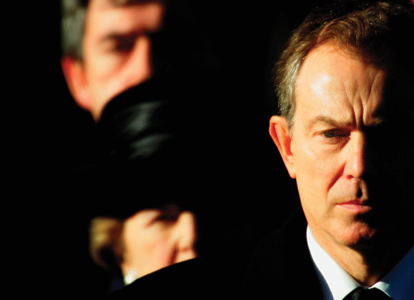
 Tony Blair: Man of mystery (Getty Images)
Tony Blair is one of the most mysterious figures in our political history, and likely to remain so. His memoir, though surprisingly well-written in places — his opening chapter describing the night he became Prime Minister is hugely entertaining — and often jarringly sharp amid oceans of soft soap, tells us little about him we did not already know. Historians will find him harder to deconstruct and put together again in a recognisable category than even Lloyd George.
The one certain thing about him is his ability to attract voters. He was by far the most successful Labour leader, making Ramsay MacDonald, Clement Attlee and Harold Wilson seem marginal by comparison. His victory in 1997, giving Labour a majority of 179 over all other parties combined, was without precedent and made the 1945 landslide seem tame.
Moreover, unlike Attlee, he was very much the personal victor, displaying a genius for attracting normally Tory voters, especially in the south of England. He captured places like Hove and Hastings, Crawley, Worcester, Basildon and Harrow, and retained them in the following two elections.
I have no doubt at all that had he not weakly and perhaps also generously ceded the premiership to Gordon Brown while his lacklustre colleagues idiotically allowed it to happen, Blair would have won a fourth victory, and would be Prime Minister today. So long as he remained Labour leader, a Tory revival was impossible.
The reason for this is elementary. Blair calls himself New Labour, and insists on the metaphysical as well as the programmatic significance of the term. But by instinct and conviction, he is body and soul a Tory, albeit in some ways a radical one, like Canning, Peel, Joe Chamberlain and Baldwin. His father was the foster-child of a Glasgow rigger in the Govan shipyard, an upwardly mobile go-getter who had a good war, was promoted to major, and thereafter became a barrister and a staunch Conservative activist. He was in line for the nomination of the safe Tory seat of Hexham in 1964, when suddenly incapacitated by a stroke. Had he become a Tory MP we can be certain that Blair would have followed him.
Indeed, I have never been able to detect, in his behaviour or speeches, any evidence of bedrock Labour sentiments, and this memoir fails totally to explain why he drifted into the party. There was never any real reason. It was happenstance. Or rather I prefer the Quixotic explanation offered by his former housemaster at Fettes, Eric Anderson and his wife Poppy. Blair was always a consummate actor, and was given the part of Anthony in the school production of Julius Caesar, although not yet a senior boy. He had a startling success in the part, as one would expect. Poppy did the costumes, and dressed the followers of Brutus in blue. Anthony and his men wore red. "And that," she said, "was how Blair became Labour."
I prefer this explanation because Blair has always struck me as profoundly ignorant of Labour party history. He refers to his "political heritage" as springing from "Lloyd George, Keynes and Beveridge as well as Attlee, Bevin and Keir Hardie". But this is just waffle. I am sure he has never read the Beveridge Report, or Keynes's General Theory or Tony Crosland's Future of Socialism, to which he also pays ritual tribute. He likewise renders glowing thanks to Roy Jenkins as a mentor, but I doubt if he has ever finished one of Roy's books (he may have begun one or two) and the Jenkins he reveres is the member of the Gang of Four, not the Labour Cabinet minister. When I first met Blair, I was surprised to find he knew nothing of Bevanism, and Nye Bevan does not once appear in his memoir, though Michael Foot gets a brief mention.
People he cannot prevent himself from admiring tend to be Tories, sometimes surprising ones. In his memoir there is a long and touching tribute to Neville Chamberlain and his peace efforts, inspired by his diaries, which Blair dipped into when at a loss for anything to do in the Chequers library. His admiration for Margaret Thatcher was unbounded and had he followed his father and become a Tory MP he would have been her natural successor. Indeed, I possess the original of a Peter Brookes cartoon illustrating this very point. His one reservation about Thatcher is that he thinks she mishandled the Heseltine problem, her equivalent of his own Brown problem. He thinks she should have made Heseltine her successor. I can see why he admired Heseltine, a politician like himself with superb presentational skills and no fundamental convictions. But he fails to grasp that Thatcher saw Heseltine as essentially destructive in his self-seeking ambition, and got rid of him — as Blair himself fatally failed to get rid of the destructively self-seeking Brown. Thatcher's own choice as a successor, John Major, though feeble and unmemorable, at least won an election, which Heseltine would certainly have lost — in which case history, including Blair's own, would have been quite different.
Blair's instinctual conservatism expresses itself in various ways. One is his good manners. He has the best manners of any political leader I have come across, here or abroad. I happen to believe manners are important, in theological terms an outward sign of inward grace. They spring, certainly in Blair's case, from a profound love of order, which is illustrated, time and again, in his memoir. If there is one thing he hates, it is any kind of criminal behaviour. If there is one additional reason for occupying Iraq and Afghanistan, besides the ones he gives, it is because he saw both as disorderly societies, a menace to their peoples, their immediate neighbours and the world as a whole. He wanted to make them orderly and harmless, and thus took on a task beyond, perhaps, anyone's power.
A further, and related instinct, also a conservative one, was his admiration for the United States, its freedom, dynamism and populist politics. With his ability to appeal to a wide range of people, and his minimal ideological baggage, Blair would have made a first-class American politician, and an admirable President.
He got on well with both the US leaders with whom he had dealings, and liked and admired them. Bill Clinton, he argues, had an extraordinary rapport with ordinary people. This, he says, is what he strove for himself "but as a political class act I defer to the master". He adds: "He had it all. His superb intellect was often hidden by his manner, but he had incredible analytical ability, was genuinely interested in policy debate...and constantly on the lookout for new ideas." Again: "Clinton's great political strength was an endless capacity to be fascinated even by the most unfascinating people because he was always willing to learn from them."
He also admired Bush for a quite different reason: decisive leadership. Of all the leaders he met, he rated Bush among the highest for this, and for integrity, as well as courage. In his memoir he describes Bush on a number of occasions, and it seems to me he got the man exactly right. He found the hostility to Bush he came across in his party incomprehensible, based on gut reaction which defied rational analysis. His liking, even affection, for Bush was fully returned, as I can testify.
Indeed it is a curious fact that Blair, that mysterious figure, emerges most clearly in his reasons for liking particular people. And it is particularly revealing when his liking is grudging. A case in point is Princess Anne. When the Blairs first stayed at Balmoral she called Cherie "Mrs Blair". This brought out the inevitable "Please call me Cherie", which in turn brought out "Actually, I prefer Mrs Blair." Of course, the Princess had no intention of allowing a Prime Minister's wife to call her "Anne", which would be the inevitable outcome of familiarity, though Blair is too good-mannered to say so. He says: "I always liked [Anne]. I doubt the feeling was mutual, or perhaps more accurately she was indifferent."
She is a chip right off the old man's block. People think Prince Philip doesn't give a damn what people think of him, and they are right: he doesn't. Anne is exactly the same. She is what she is, and if you don't like it you can clear off. It is not a quality I have, but I admire those who do.
Blair feels the same, ceteris paribus, about Rupert Murdoch, and one of the most touching things to emerge from this memoir is Blair's half-formulated desire to be much more ruthless, at a personal level, than he is. But it is beyond him. One cannot see him, like Lloyd George, snarling at a colleague: "I want him dead chicken by midnight" or, like Churchill, marching up and down the Cabinet room, saying aloud to himself, "I want them all to feel my power." The various criticisms he makes of the awful Gordon Brown add up to a devastating indictment, but he cannot refrain from putting in bits about Brown's brilliance, sincerity, idealism etc. In an earlier age, Blair would have found it impossible to sign a death warrant. He is the smiler without the knife.
But this may turn out to be a blessing. Blair's journey, as he calls it, is not over yet. He is still youngish, vigorous, healthy, unbroken in spirit, and optimistic. He has not made the mistake of imprisoning himself in that whited sepulchre the House of Lords, or that eunuch's harem the Brussels bureaucracy. The British political system is moving into uncharted waters. If, as I suspect, both the Liberal Democrats and the Labour Party will shortly split, Blair would be well placed to unite and lead the responsible rumps of both. Stranger things have happened. In an age of coalitions, Blair is by far the best equipped to be a natural, instinctive and happy coalition leader, unburdened by convictions and enemies. He is a valuable national asset and I for one hope the country finds further use for him.


1:11 PM
1:11 PM
12:10 AM
12:10 AM
5:10 PM
4:10 PM
10:10 PM
8:10 PM