



Sixty-five years ago, the victorious British Army arrived in what is now Indonesia on what they believed was a humanitarian mission. Instead, the British walked unwittingly into a war of independence, the first step along a path that has led the army through many messy post-colonial conflicts and ultimately to the quagmires of Afghanistan and Iraq.
The flashpoint was the port of Surabaya in eastern Java. On October 25, 1945, a brigade of Indian troops sailed into the harbour on a mission to locate and repatriate prisoners of war and civilians interned by the Japanese. They were unprepared for the heavily armed nationalist militia that controlled the city. Five days later, their commanding officer, Brigadier A. W. S. Mallaby was dead, along with a couple of hundred of his men, and the British were haplessly embroiled in the independence struggle between the Indonesians and their Dutch colonial rulers.
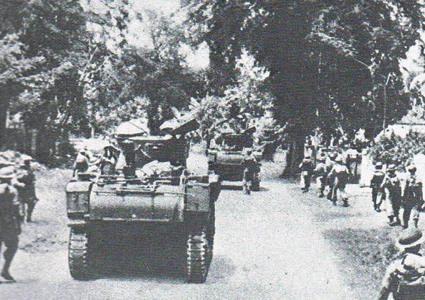 British and Indian troops advancing in Surabaya in November 1945
How this came about, and what happened over the next year, remains instructive.
Asia and the Japanese war had been secondary to strategic thinking in both London and Washington. Beating Hitler had been the prime objective. But while the Americans with their industrial strength and large population had been able to prosecute a vigorous campaign against Japanese forces in the Pacific, the British effort in Burma had been a hand-to-mouth, sometimes desperate affair.
The abrupt end of the Japanese war on August 15 posed a new challenge: how to administer the vast areas still occupied by the Japanese. There had been an agreement that the British would be responsible for Burma, Thailand, Malaya and Hong Kong. But at the Potsdam Conference in July, the Americans had unexpectedly asked the British to take responsibility for Indonesia and part of Indochina. The British had little intelligence on local conditions. It did not help that halfway through Potsdam Winston Churchill lost the historic general election, and Labour's Clement Attlee took his place at the conference table.
The situation was complicated by American determination to discourage the return of European colonial rule. Although the Americans had greatly increased the burden on British forces in Asia, they also refused to make merchant shipping available to help them. This made it hard for the British to fulfil their duties with any speed.
In charge of Southeast Asia Command (SEAC) was Admiral Lord Louis Mountbatten. His orders were to occupy surrendered territory, repatriate prisoners of war and maintain good order until civil power could be reconstituted. Logistically, it was an enormous task, even without opposition. At his disposal were the battle-hardened 14th Army, fresh from victory in Burma, plus limited naval and air resources. But the British troops — about one-third of the total — were eager to return to Britain, where the Labour government was setting about the new Jerusalem, while their Indian comrades knew that their country's independence was only a couple of years away.


- Now Or Never
- Who Will Heal This Divided Country?
- What Made The West Great Is What Will Save Us
- Shock And Awe: Tales Of A Washington Insider
- We Shouldn't Let Old Men Rot Away In Jail
- Arnold Wesker’s Bid To Build A New Jerusalem
- Our EU Deal Gives Us The Best Of Both Worlds
- Brexit Would Save Us And Set Europe An Example
- Are Both Sides Playing By The Referendum Rules?
- Should We Stay Or Should We Go?
- Ignore Project Fear: Brexit Won't Ruin Us
- Uncontrolled Immigration Means Finis Britanniae
- The Next US President Must Carry A Big Stick
- Can Clinton Or Trump Crack The US Tax Code?
- How to Survive the Fourth Industrial Revolution
- The Spectre Of Mayor Khan's Islamist London
- Students Are Leading The Free Speech Fightback
- Fortress Europe Faces An African Migrant Tsunami
- Trump May Be Bad, But What Comes Next Will Be Worse
- Myth Of Stressed-Out Soldiers On The Street

1:05 PM
12:04 PM
3:02 AM
1:11 PM
3:06 PM