


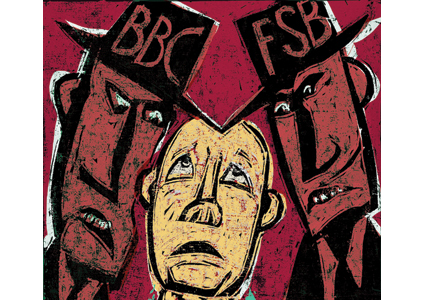
 Illustration by Daniel Pudles
The telephone rang just after 8.30pm on December 19, 2006. I was at home entertaining a friend. It was a BBC Russian Service senior editor, wanting to talk to me about my programme The Life and Death of Alexander Litvinenko, which he had just heard on air, and he could not wait. The programme was biased, he said, it pointed the finger of blame at Moscow. "Just imagine," he exclaimed, "this man in the Kremlin who monitors our output. What will he say about your feature?"
I was rather surprised, but managed to give him the only answer that seemed reasonable under the circumstances: "I do not work for a man in the Kremlin," I said. "I work for the BBC. And I observed all the BBC's guidelines about balance by giving airtime to both sides, since I have Kremlin supporters in my programme as well as its critics."
"Yes", the editor responded, "but the pro-Kremlin guys sound stupid and [Vladimir] Bukovsky [a Soviet-era dissident] and the others sound intelligent." This is hardly my fault, I thought.
My feature went out for the first time on December 18, three weeks after Litvinenko's death and two months after I heard him speak in public for the last time. It was at the London Frontline Club — a haunt of London's war correspondents — at an event devoted to the murder of the Russian journalist Anna Politkovskaya. In this, now famous, speech, Litvinenko rose from his seat in the audience and accused the then Russian President, now Prime Minister, Vladimir Putin, of Politkovskaya's murder. He spoke with pain and passion about Politkovskaya, who was his personal friend, and the threats she received, especially after the publication of her book Putin's Russia. The speech was not reported by the Russian Service even when, after Litvinenko's poisoning and death, the video recording of it became available on the Frontline Club's website. I tried to draw the attention of several editors to it, but letting Russian listeners know that Litvinenko was a critic of the Kremlin did not seem to interest them. Moreover, nobody seemed to pay any attention to the fact that the Russian Service was in possession of an exclusive 50-minute interview in Russian with Litvinenko, recorded in 2002, which could have shed light on his life and his views, and that our BBC colleagues broadcasting in English would have been grateful to have it in translation.
With Russian officials dismissing Litvinenko as a "nobody" and the British media consistently calling him a spy (he was neither), I thought it was my task to try to give our audience in Russia as much information about the murdered man as I could. Apart from the speech in the Frontline Club and extracts from the Russian Service's 2002 interview, I also used clips from an interview with him in a Dutch documentary available on the internet. As it turned out, it was precisely the voice of the murdered man that my bosses did not want to hear.


- The Spectre Of Mayor Khan's Islamist London
- Students Are Leading The Free Speech Fightback
- Fortress Europe Faces An African Migrant Tsunami
- Trump May Be Bad, But What Comes Next Will Be Worse
- Myth Of Stressed-Out Soldiers On The Street
- The Russian Love Affair With Palmyra Resumes
- How Russia Is Ruled By The Putin Doctrine
- The Doors Of Holocaust Memory Are Closing
- Rediscovering The Point Of Language
- The Novelist For Whom Small Was Beautiful
- A Recipe For Disaster
- Culture And Politics In The Age Of Trumpery
- Will Labour Listen To Its Eurosceptic Voters?
- Would Brexit Play Into Putin's Hands?
- Why Brexit Could Be A Blessing For Europe
- Will The Pollsters Get It Right On The Referendum?
- The Great Illusion: Why We Are Still Europe’s Fall Guys
- Make June 23 Britain’s Independence Day
- Don't Pit Generations Against Each Other
- Let Justice Be Done Though The Liberal Heavens Fall

- Shame On The Liberals Who Rationalise Terror
- The Cowardice Of John Le Carré
- The Establishment Is In Denial — Yet Again
- Is There A Right Way To Write?
- A Fascist Coup In Poland? Give Us Poles A Break
- The Stalinist Past Of Corbyn’s Strategist
- The Spectre Of Mayor Khan's Islamist London
- The Long Shadow Of Malthus
- Shame On The Liberals Who Rationalise Terror
- The Cowardice Of John Le Carré
- The Establishment Is In Denial — Yet Again
- Is There A Right Way To Write?
- A Fascist Coup In Poland? Give Us Poles A Break
- The Stalinist Past Of Corbyn’s Strategist
- The Spectre Of Mayor Khan's Islamist London
- The Long Shadow Of Malthus
- Shame On The Liberals Who Rationalise Terror
- The Cowardice Of John Le Carré
- The Establishment Is In Denial — Yet Again
- Is There A Right Way To Write?
- Did Burke Betray The Cause Of Liberty?
- A Fascist Coup In Poland? Give Us Poles A Break
- Double Games Of The UK Muslim Brotherhood
- Two Languages And The Chasm Between Them
4:02 PM
8:11 PM
7:11 PM
12:11 PM
5:10 AM
2:10 PM
7:10 PM