


You cannot know the chance of very unlikely events by observing how often they occur. They do not occur often enough for that. But you can still sometimes know their probability. For example, we know that the probability of 100 consecutive coin tosses landing heads is 1/2100, not because we have seen this happen, but because we know that the probability of each toss landing heads is 1/2.
For many other improbable events, however, the matter is not so simple. Not only are they too rare to observe their long-run frequency, but we do not understand their underlying causes well enough. For example, because the causes of weather and of economic events are so varied and complicated in their interactions, meteorology and economics remain inexact sciences, unable to tell us the chances of unlikely, extreme events.
And because we humans are inclined to certain errors of reasoning, such as seeing patterns where there are none and underestimating the chance of things we have not previously seen, we get shafted by unlikely events more often than is strictly necessary.
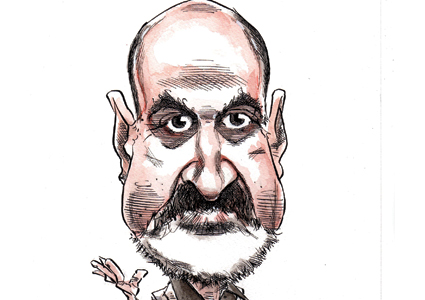
This is a short version of The Black Swan, the 2007 best-seller by Nassim Nicholas Taleb, a (now) 50-year-old Lebanese former investment banker. His Fooled by Randomness, published in 2001, explored similar themes. But it did not enjoy the same success because its timing was not as good: Black Swan was published during a financial crisis that Taleb had predicted.
He was quickly propelled to stardom. Bryan Appleyard described him in the Sunday Times as "the hottest thinker in the world". He has since added a post at Oxford University's Said Business School to his position at the Polytechnic Institute of New York University, and he is in great demand on the speaking circuit.
It is ironic that Taleb should be credited with genius on account of the coincidence of Black Swan's publication with a financial crisis he had predicted. It displays exactly the kind of erroneous thinking that he complains of. If the financial crisis were an unlikely "black swan" event of the kind that Taleb discusses, then he could not have known its probability.
Taleb's central hypothesis in Black Swan is right. But it is simple and worth only a chapter rather than an entire book. Taleb inflates its significance with an absurdly combative and grandiose writing style. It is Taleb versus the corrupt fools of the financial establishment; Taleb versus the false mathematical rigour of the academy; Taleb returning us to the wisdom of the ages.
The padding that fattens the Black Swan up from a chapter to a book is worse than irrelevant fluff; it is angry, righteous and self-congratulatory. It also hints at a flimsy grasp of the non-financial subjects he strays on to and of the philosophy of science.
Taleb's scepticism is not restricted to the chance of very unlikely events. He thinks that we generally know less than we think, and that economics and much of modern science is bunkum. The Nobel Prize for economics and its winners cause him special psychic pain. At a conference in Mexico in 2009 (which you can see on YouTube) he claimed that the supposed knowledge of modern doctors has made no contribution to extending our life expectancy. The human body, like the weather and the economy, is too complex to be amenable to science. As evidence, he claimed that when elective surgery is briefly suspended (perhaps because of a strike), death rates do not increase. I will not insult you by pointing to the well-known facts that contradict this scepticism about modern medicine, nor explain how Taleb's "evidence" could be correct without supporting his conclusion.
Taleb's extra-curricular absurdities are often expressed in the style of a post-modernist literature student. He talks about "narratives", "reductive categories" and "what lies on the other side of the veil of opacity". He thinks that claims about the origins of the universe or the reality of death need no evidence when uttered by the religious, because they are using holy terms rather than scientific ones. He thereby endorses the relativists' fantasy that a mere choice of jargon can absolve you of all intellectual obligations.
He has now published a book of aphorisms, The Bed of Procrustes, heavily promoted on the BBC Today programme. A collection of aphorisms would usually be assembled by a fan after a lifetime of brilliant work and pithy nuggets of wisdom. But Taleb cannot wait, nor rely on others fully to appreciate his wisdom. So he has delivered his own collection of freshly-cooked nuggets. It is not only the vanity of the enterprise but the aphorisms themselves that are excruciating. They reveal Taleb's obsession with a handful of topics, but mainly with himself: erudition (that's him), charm (him), wisdom (him), nerds (not him), the internet (which is for nerds, not him), philosophers (him), suckers (not him), hard work (which is not for geniuses like him), paid academics (not him, except in fact) and the great men of antiquity (of whom he is a late example). If only it were true.


- Shame On The Liberals Who Rationalise Terror
- The Establishment Is In Denial — Yet Again
- Is There A Right Way To Write?
- A Fascist Coup In Poland? Give Us Poles A Break
- The Cowardice Of John Le Carré
- The Year Of "Social Justice"
- The Stalinist Past Of Corbyn’s Strategist
- France, Islam, And The Second Class Sex
- Shame On The Liberals Who Rationalise Terror
- The Establishment Is In Denial — Yet Again
- Is There A Right Way To Write?
- A Fascist Coup In Poland? Give Us Poles A Break
- The Cowardice Of John Le Carré
- The Year Of "Social Justice"
- The Stalinist Past Of Corbyn’s Strategist
- France, Islam, And The Second Class Sex
10:12 PM
11:12 PM
2:12 PM
8:12 AM
3:12 AM
1:12 AM
12:12 AM
11:12 PM
9:12 PM
4:12 PM