



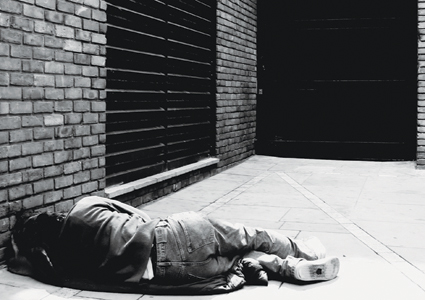
 A disillusioned Dick Whittington? The number of rough sleepers in London has more than doubled in the past five years (CP Grey CC BY-SA 2.0)
“I have to see everything for myself. I don’t trust statistics. I don’t trust columnists. I don’t trust self-appointed spokesmen. I have to make up my own mind.” The declamatory opening of Ben Judah’s This is London, which started life as a dispatch for Standpoint, could be that of a Hollywood blockbuster, the voiceover of a lone-ranger hero, spoken as the camera pans over a stark wasteland. Except that apocalyptic scene is nothing so dramatic as daily London life in the 21st-century.
From that opening hook, the reader cannot help but be sucked into Judah’s London, accompanying him on his epic journey through the modern city, armed only with a tape recorder, notepad, and a hell of a lot of stamina. Each of the 25 areas he visits, from Peckham to Newham, via Berkeley Square and White City, is designated a chapter, filled with grim, undoctored photos, and populated vividly with the “new Londoners”. These are the foreign immigrants, disillusioned Dick Whittingtons who are flocking to the city they’ve been told is paved with gold, only to discover the harsh reality. It is a masterly — and deeply depressing — portrait of London today, as shocking as it is necessary.
Somewhat ironically, the Londoners who actually read Judah’s book are most likely to be, like him, in that dwindling minority of middle-class white Brits. At least 55 per cent of Londoners today are not British-born, and illegal immigrants make up 5 per cent of the population, says Judah. Thus the majority, regardless of how militantly politically correct they might be, are likely to sympathise with Judah’s motive: “I was born in London but I no longer recognise this city. I don’t know if I love the new London or if it frightens me . . . I have no idea who these new Londoners are. Or even what their London really is.”
A sorry carousel of those living “in the shadows” passes before the reader: the Underground cleaners forced to witness suicides, the contract hospital workers travelling all over the capital at a moment’s notice, the Polish cash-in-hand builders renovating Kensington oligarchs’ mega-mansions for less than £4 an hour. Such people live packed like rats in dosshouses (in which Judah, pretending to be a Russian immigrant, stays) on the outskirts of a London that appears to have reverted to a Victorian hell. Countless numbers of helpless people are stuck working themselves to the bone for next to nothing (interestingly, aprt from the homeless Roma, Judah doesn’t meet any unemployed immigrants living off the state).
Like this article? Share, save or print using the icons below:


